This work uses causal optimal transport to define loss functions that identify a minimum-entropy control for guidance under minimal assumptions in conditioned generative models.
Abstract
Current conditioned generative models heavily rely on score functions for guidance during training. When the generative model is a diffusion process with a singular diffusion coefficient and the underlying (conditional) densities either do not exist or are not smooth, we use causal optimal transport to define \emph{approximate} loss functions that identify a minimum-entropy control for guidance under minimal assumptions. Our approach relies on causal optimal transport and its characterization through the predictable representation property of (conditioned) diffusion processes whose associated martingale problem is well posed, \`a la \"Ust\"unel.
We study generative bootstrap processes obtained by resampling from fitted generative distributions. We establish necessary and sufficient conditions for their conditional weak convergence to the $P$-Brownian bridge, formulated in terms of finite-dimensional conditional weak convergence and conditional asymptotic equic...
Deterministic neural networks and neural operators provide point predictions with no intrinsic measure of reliability. Yet, predictive uncertainty may stem from irreducible outcome variability, finite data, or limitations of the chosen model class. Monte Carlo dropout offers a computationally convenient way to construc...
Giacomo Lorenzon, Francesco Regazzoni· 0 citations
A conditioning mechanism for diffusion models based on multi-speed joint diffusion of the target and the condition learns an unconditional joint score network and enforces conditioning at inference via a plug-in correction term, and derives explicit conditional reverse-time SDEs and approximate probability-flow ODEs.
Libo Chen, Souvik Ghosh, Teo Deveney et al.· 0 citations
Diffusion models have revolutionized generative modeling for continuous data through the gradual refinement of a belief state. This iterative refinement has not yet carried over to discrete diffusion models, which discard uncertainty at intermediate steps through categorical sampling (information collapse). We propose...
Justin Deschenaux, Alexandre Galashov, Andrew Campbell et al.· 1 citation
A framework for designing the reference process that achieves tractable time-dependent conditional distributions and then construct the reference process realizing them as its marginals is proposed, revealing that score matching is not fundamental to diffusion-model training but instead emerges naturally through revers...
Simplax is introduced, an exact Dirichlet--categorical augmentation that couples each corrupted categorical state with an auxiliary simplex-valued variable while preserving the original uniform diffusion process as its categorical marginal.
Jinya Sakurai, Patrick Pynadath, Satoshi Hayakawa et al.· 1 citation
Adaptive AI agents can help make BIM data more machine-readable by navigating IFC models, interpreting inconsistent information, and mapping it to defined standards. In this blog, Alok Rawat shares findings from a real-world pilot in construction workflows. The post Adaptive AI Agents in Construction Workflows appeared first on GPT-Lab.
What does it take to trust AI-driven HVAC optimization? Our AI Model Factory combines agents, machine learning, reinforcement learning and deterministic checks in a governed workflow designed for messy, real-world building data. The post We built an AI factory for HVAC control appeared first on GPT-Lab.
MIT News · Artificial Intelligence· news.mit.eduAug 18, 2026
A new method for surgically removing training examples from a model reveals that as datasets grow, the link between what a model learns and what it produces dissolves.
Microsoft Research Blog· microsoft.comJul 30, 2026
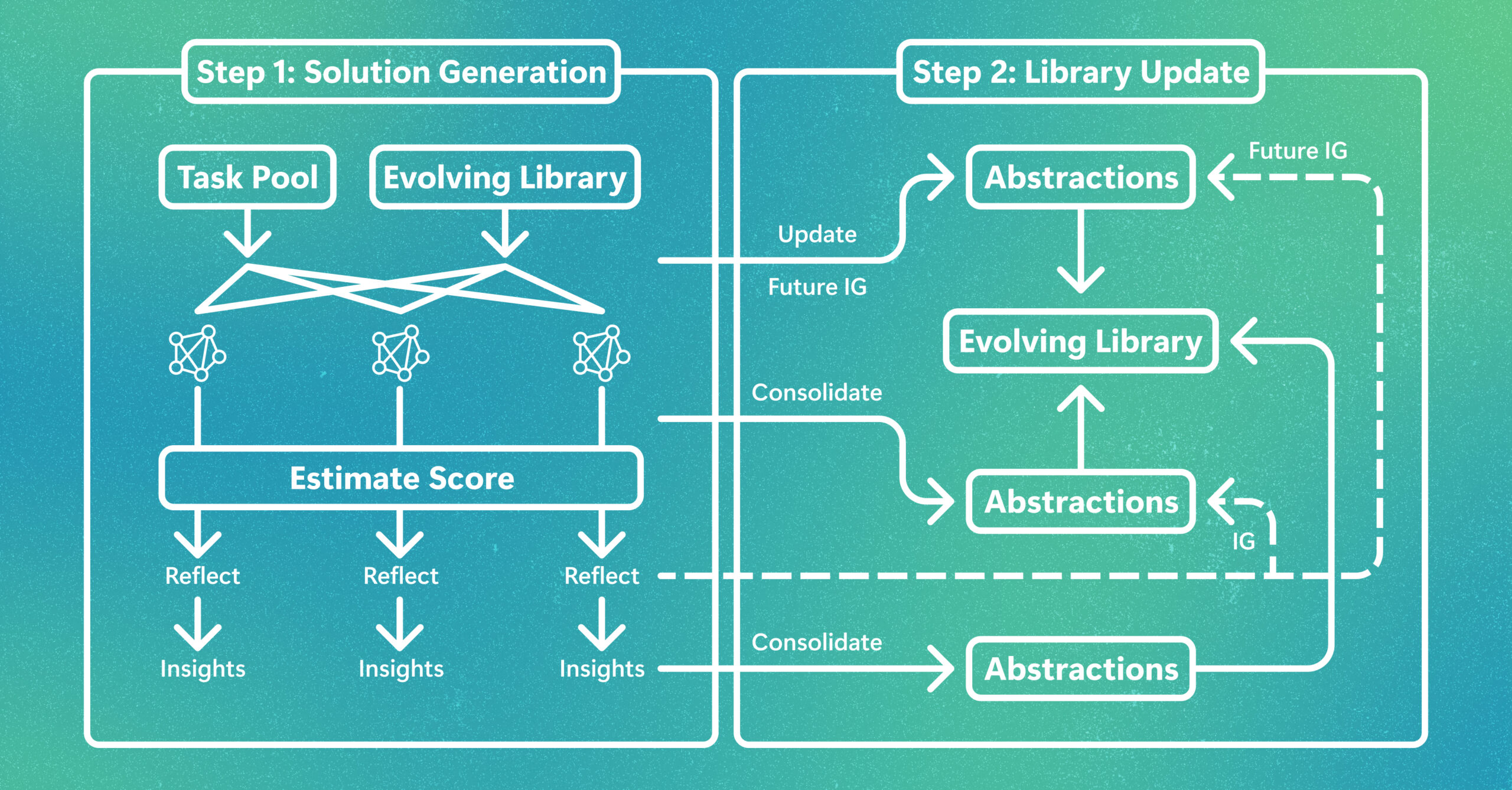
LLMs do not get smarter just by remembering more. EvoLib turns experience into evolving knowledge, taking reusable skills and insights that help models learn and adapt across tasks long after deployment. The post EvoLib: Turning experience into evolving knowledge appeared first on Microsoft Research.
We use cookies to run the site and, with your consent, for analytics and to show ads.
See our Cookie Policy.