Sep 2026· Journal of Chemical Information and Modeling· 0 citations· 191 references
Computer Science
TL;DR
A comprehensive evaluation of molecule generation models for de novo drug design, covering 82 methods across five deep generative frameworks, including recurrent neural network (RNN)- and transformer-based models, variational autoencoders (VAEs), generative adversarial networks (GANs), flow-based models, and diffusion models are presented.
Abstract
Molecule generation has emerged as a powerful computational tool for de novo drug design, enabling the exploration of the chemical space beyond the limits of conventional virtual screening. The field has progressed rapidly, driven by advances in molecular representations, generative architectures, and target-aware modeling strategies. However, existing reviews typically address specific model families or application scenarios in isolation rather than offering an integrated perspective on how these components collectively form a coherent generation workflow. In this review, we present a comprehensive evaluation of molecule generation models for de novo drug design, covering 82 methods across five deep generative frameworks, including recurrent neural network (RNN)- and transformer-based models, variational autoencoders (VAEs), generative adversarial networks (GANs), flow-based models, and diffusion models. We first summarize widely used benchmarks and molecular representations and then examine the methodological principles underlying both general and pocket-conditioned generation. A central contribution of this work is a systematic synthesis and comparative analysis of the reported performance across commonly used benchmarks and evaluation metrics. We also summarize representative experimentally validated cases. Looking ahead, we discuss future directions in standardized 3D data, interaction-aware generation, receptor flexibility, and multiobjective molecular design, with the aim of improving the reliability and experimental relevance of molecule generation. All collected benchmark resources, evaluation metrics, and model references are provided in a publicly accessible repository at https://github.com/JacklinGroup/molecule-generation-review.

A state-aware functional classifier (SAFC) is developed that integrates molecular dynamics derived receptor ensembles, ensemble docking and protein ligand interaction graphs that provides dynamics-aware functional activity rankings for generated molecules that were partly complementary to docking, drug-likeness and syn...
H. Kumar, Zheng-Xiao Yang, Yankai Yu et al.· bioRxiv· 0 citations
To bridge the gap between in silico predictions, chemical synthesis, and biological reality, emerging solutions such as federated learning, causality-aware Explainable AI, closed-loop autonomous laboratories, and efficiency-oriented algorithmic strategies are explored.
Xue-Yuan Bi, Yang-Yang Wang, Ji-Han Wang et al.· Frontiers in Pharmacology· 0 citations
A comprehensive review of how Artificial Intelligence and Machine Learning are redefining this landscape across three critical dimensions outlines the transition toward end‐to‐end, adaptive discovery systems that ensure computational hits are biologically potent, structurally optimized, and synthetically accessible.
Yi-Fei Wang, Nupur Bansal, Shiyun Wa et al.· WIREs Computational Molecula...· 0 citations
CRAFT is a reaction-aware molecular optimization framework that integrates Monte Carlo Tree Search (MCTS) with a multimodal strategy network and explicitly encodes two-dimensional molecular topology and atom-level reaction roles, enabling chemically feasible transformations during multi-step optimization.
Run-Fu Yu, Tong-Mao Ma, Zian Song et al.· Journal of Medicinal Chemist...· 0 citations
Adaptive AI agents can help make BIM data more machine-readable by navigating IFC models, interpreting inconsistent information, and mapping it to defined standards. In this blog, Alok Rawat shares findings from a real-world pilot in construction workflows. The post Adaptive AI Agents in Construction Workflows appeared first on GPT-Lab.
What does it take to trust AI-driven HVAC optimization? Our AI Model Factory combines agents, machine learning, reinforcement learning and deterministic checks in a governed workflow designed for messy, real-world building data. The post We built an AI factory for HVAC control appeared first on GPT-Lab.
MIT News · Artificial Intelligence· news.mit.eduAug 18, 2026
A new method for surgically removing training examples from a model reveals that as datasets grow, the link between what a model learns and what it produces dissolves.
Microsoft Research Blog· microsoft.comJul 30, 2026
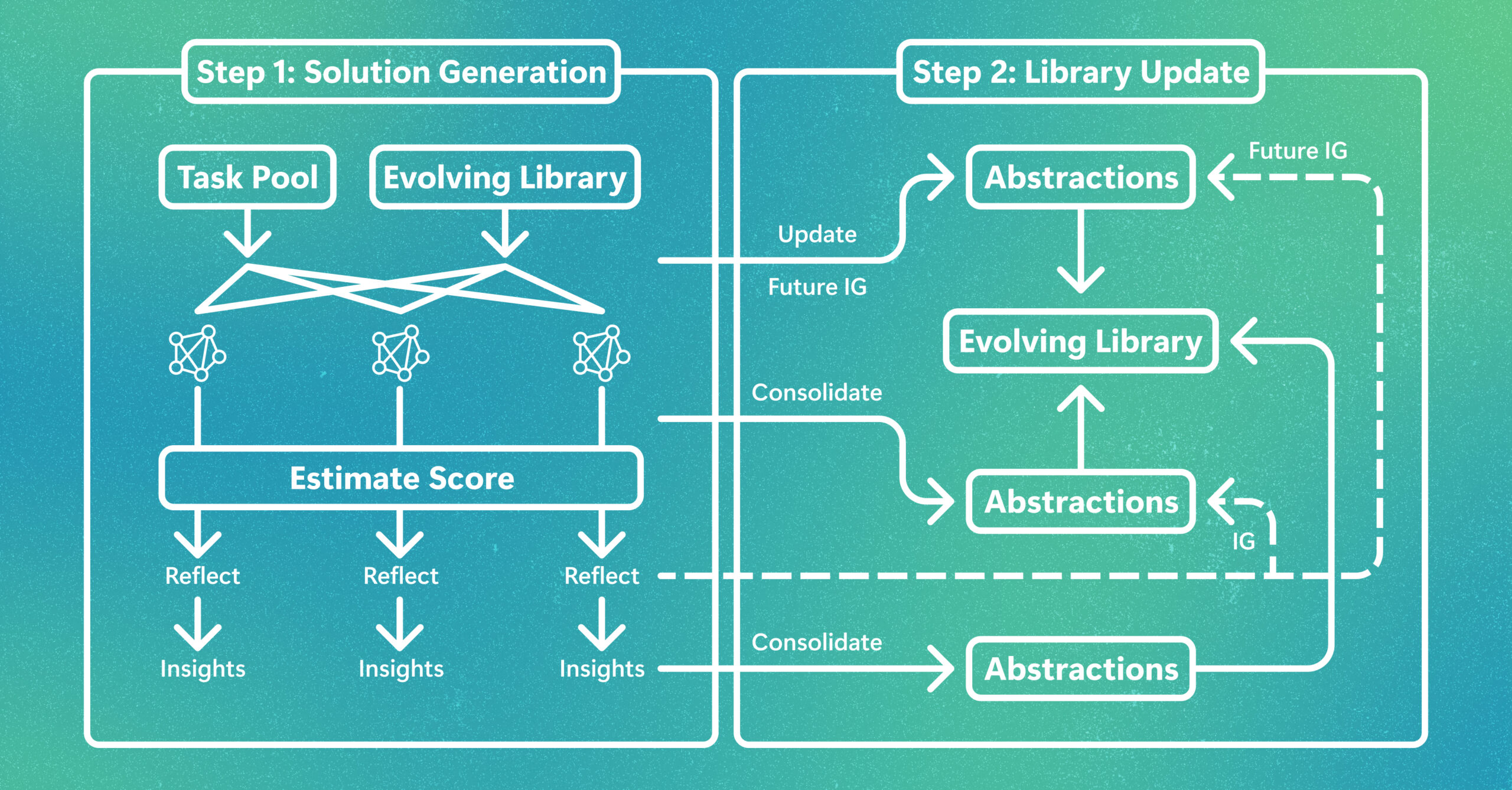
LLMs do not get smarter just by remembering more. EvoLib turns experience into evolving knowledge, taking reusable skills and insights that help models learn and adapt across tasks long after deployment. The post EvoLib: Turning experience into evolving knowledge appeared first on Microsoft Research.
We use cookies to run the site and, with your consent, for analytics and to show ads.
See our Cookie Policy.