Mar 2026· IEEE Transactions on Audio, Speech, and Language Processing· Vol abs/2603.02724· 0 citations· 46 references
Computer Science
TL;DR
A data augmentation strategy based on simulated acoustic transfer functions (ATFs) that expose the model to a wide range of spatial propagation conditions and highlights the potential of simulation-based training for enabling practical single-microphone OVD systems in hearing aids.

Abstract
This paper presents a simulation-based approach to own voice detection (OVD) in hearing aids using a single microphone. While OVD can significantly improve user comfort and speech intelligibility, enabling reliable OVD with a single microphone is desirable for simplifying hardware and reducing power consumption in compact hearing devices. However, most existing solutions rely on multiple microphones or additional sensors, increasing device complexity and cost. To enable ML-based OVD without requiring costly transfer-function measurements, we propose a data augmentation strategy based on simulated acoustic transfer functions (ATFs) that expose the model to a wide range of spatial propagation conditions. A transformer-based classifier is trained using analytically generated ATFs and further fine-tuned using numerically simulated ATFs with increasing geometric realism. This hierarchical adaptation enables the model to refine its spatial understanding while maintaining generalization. Experimental results show 95.52% accuracy on simulated head-and-torso test data and 90.02% accuracy for one-second speech segments, demonstrating robustness to short durations. When evaluated on real-world hearing-aid recordings, few-shot fine-tuning using a small subset achieves 91% accuracy, demonstrating that limited real-world data can effectively adapt the simulation-trained model. These results highlight the potential of simulation-based training for enabling practical single-microphone OVD systems in hearing aids.

It is found that Llama 3 delivers comparable quality to leading language models such as GPT-4 on a plethora of tasks, and performs competitively with the state-of-the-art on image, video, and speech recognition tasks.
This paper investigates developing real-world perception for active agents, proposes Gibson Environment for this purpose, and showcases a set of perceptual tasks learned therein.
F. Xia, Amir Zamir, Zhi-Yang He et al.· 2018 IEEE/CVF Conference on...· 1,069 citations· ⚡112
The results indicate that software engineering work practices are chosen opportunistically, adapted and configured to provide value under the constrains imposed by the startup context.
Nicolò Paternoster, Carmine Giardino, M. Unterkalmsteiner et al.· Information and Software Tec...· 394 citations· ⚡54
The possibility of inferring high-dimensional data inference in a model that consists of a prior and an auxiliary differentiable constraint given some additional information is considered, thereby allowing a range of potential applications in adapting models to new domains and tasks.
Alexandros Graikos, Esmeralda S. Whitammer, N. Jojic et al.· Neural Information Processin...· 316 citations· ⚡15
It is proved that any global minimizer of the trajectory balance objective can define a policy that samples exactly from the target distribution, and empirically demonstrate the benefits of the trajectories balance objective for GFlowNet convergence, diversity of generated samples, and robustness to long action sequenc...
Esmeralda S. Whitammer, Moksh Jain, Emmanuel Bengio et al.· Neural Information Processin...· 302 citations· ⚡60
An algorithm is proposed which leverages disentangled semantic factors to generate adversarial perturbation by altering controlled semantic attributes to fool the learner towards various "adversarial" targets.
Haonan Qiu, Chaowei Xiao, Lei Yang et al.· arXiv.org· 208 citations· ⚡17
Related blog posts
MIT News · Artificial Intelligence· news.mit.eduNov 17, 2026
By studying the computational foundations of language learning, Associate Professor Jacob Andreas builds intelligent systems that can communicate effectively with humans.
Microsoft Research Blog· microsoft.comNov 16, 2026
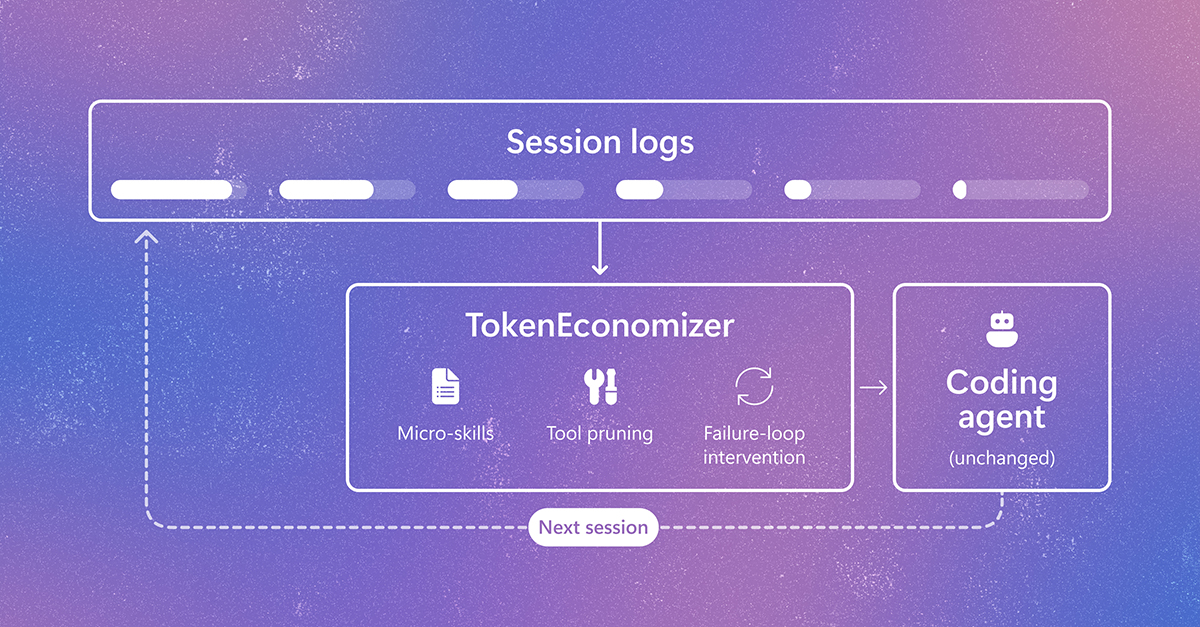
AI coding agents are increasingly help developers fix bugs and build features largely on their own, but every interaction with their models consumes tokens. In each session, an agent sends instructions, tool descriptions, and session history to its model. Most efforts to reduce this cost focus on individual tasks. Yet developers return to the same […] The post TokenEconomizer: Learning from Experience to Make AI Coding Agents More Efficient appeared first on Microsoft Research.
MIT News · Artificial Intelligence· news.mit.eduNov 13, 2026