Building a co-registered SAR-optical corpus for self-supervised Earth Observation is above all an acquisition problem, yet the main multi-modal datasets are collected opportunistically, with no per-stratum quota control and no mechanism against the geographic dropout that non-uniform cloud cover leaves behind. We prese...
Christian Sanchez-Leon, Dongming Chen, Dongqi Wang· 0 citations
Fr\'echet Distributional (FD) objectives provide an effective distribution-level signal for post-training generative models. For latent generative models, however, existing FD-based post-training methods optimize only the latent generator while keeping the decoder frozen: the decoder is trained on reconstruction latent...
Xianghong Fang, Jiajun Zhu, Esma Aimeur et al.· 0 citations
Face recognition systems are deployed widely enough that a photograph shared online can be matched without its subject's consent. Generator-based protection methods rely on heavy pretrained backbones, multi-stage inference or visible semantic edits. We introduce SSM-Attack, a black-box face privacy framework built on S...
Separating Alzheimer's Disease (AD), Parkinson's Disease (PD), and Healthy Controls (HC) using structural MRI remains challenging because disease signatures overlap and model performance can be strongly affected by data partitioning. We present HybridDualPathNet, a hybrid architecture combining EfficientNetV2-S for loc...
Jarpula Nirjala, Rahul Patel· 0 citations
Reach audiences
Advertise in front of researchers, engineers, and readers.
Emotions are expressed on a continuum and are naturally described in the valence-arousal (VA) space. Existing VA-based image editors are typically training-based and domain-specific, limiting them to VA regions seen during training and making them brittle across datasets and domains. Meanwhile, despite producing high-q...
Harvey Mannering, Zhiwu Huang, Adam Pr\"ugel-Bennett· 0 citations
Vision foundation models (VFMs) provide transferable visual representations, but their inference cost limits deployment in many settings. Fine-tuning specializes a VFM without shrinking it; distillation shrinks it, but through expensive teacher-guided training. Structured pruning offers a more direct route by extractin...
Lotfi Abdelkrim Mecharbat, Abdelrahman Elsayed, Ibrahim Almakky et al.· 0 citations
We study forecasting rigid-body motion from a single image: generating diverse and physically plausible future trajectories for arbitrary points in a scene, without building rigidity into the architecture or relying on geometric inputs such as depth. Like video generators, recent trajectory generators fail at this task...
Gabrijel Boduljak, Yushi Lan, Christian Rupprecht et al.· 0 citations
Training-stage ablations further show that financial process supervision and execution-feedback reinforcement learning yield successive improvements in both answer accuracy and GPT-5.6-judged grounded accuracy.
Chen-Xi Zhang, You-Wei Pang, Xiao-Qi Zhao et al.· 0 citations
Modern deep classifiers trained by gradient descent need many passes over the data to become accurate, and even then are not always well calibrated; post-hoc temperature scaling corrects calibration after training but cannot influence training-time accuracy or convergence. We propose a variational filtering algorithm f...
Dimitrije Markovic, Conor Heins, Alexander Tschantz et al.· 0 citations
Discovering and disambiguating entities from multimodal and heterogeneous data is a key challenge in discovery science, where relevant knowledge is often implicit and distributed across modalities. We present KARAMEL, a framework for multimodal entity linking (MEL) - the task of aligning visual and textual mentions to...
Raffaele Scaringi, Alejandro Sierra-M\'unera, Gennaro Vessio et al.· 0 citations
Hour-long videos, streaming feeds, and movie-length content are pushing vision-language models (VLMs) past their breaking point -- the standard recipe of encoding each frame into visual tokens yields sequences that grow linearly with video length, causing prohibitive memory consumption and inference latency. Existing a...
Heterogeneous medical image data motivate domain-specialized diffusion experts, but expert specialization alone does not determine how their predictions should be combined during sampling. Learning a global router is particularly challenging when the server has limited, potentially unrepresentative images. We study two...
Yaoshuai Ma, Wei Yao, Yongxiang Liu et al.· 0 citations
Exploring how generative AI could make machine vision more accessible to businesses. The post GenEye in a Box: Making Machine Vision Something You Can Just Ask For appeared first on GPT-Lab.
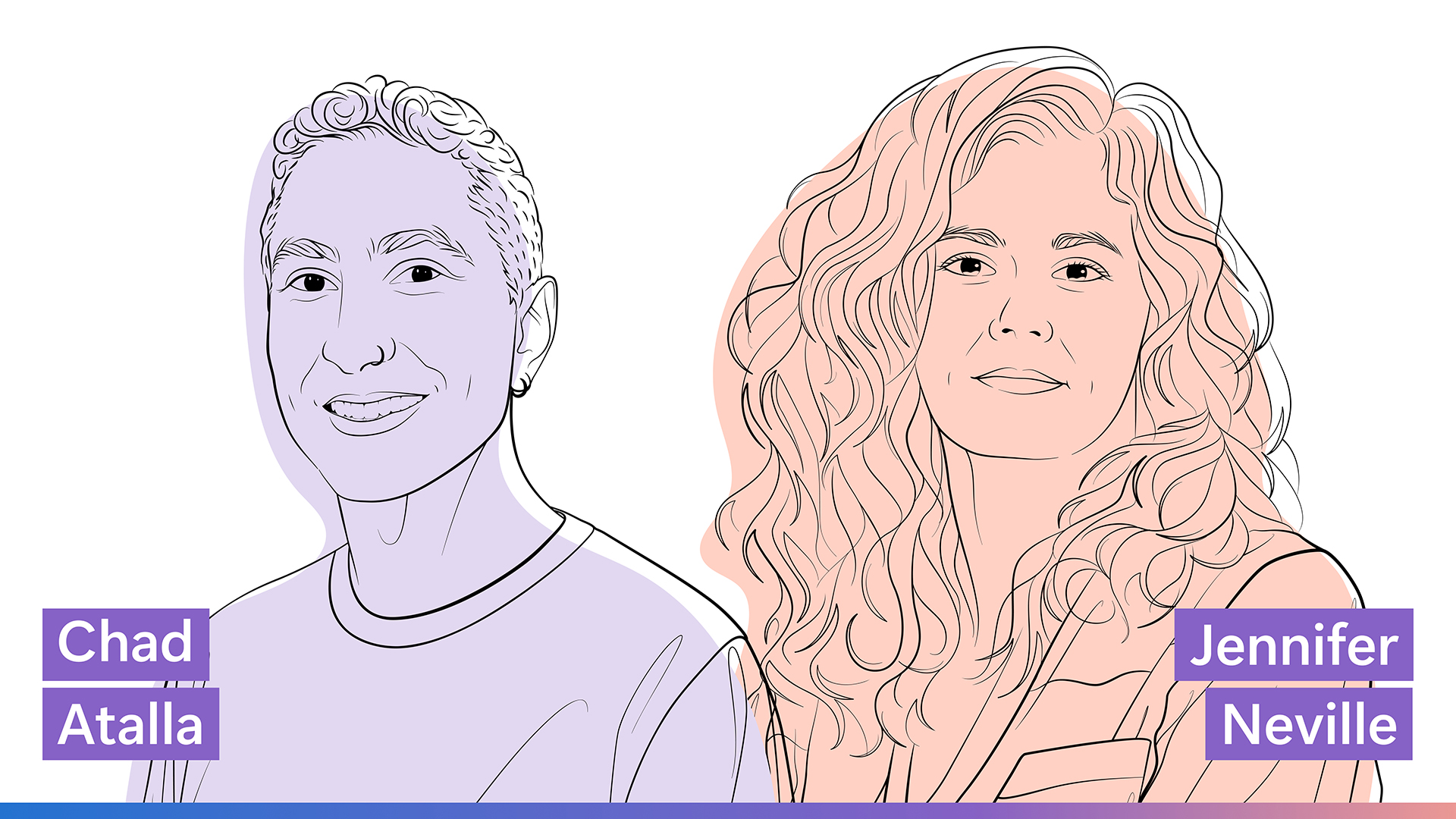
Jennifer Neville did not want to go into computer science—but that’s exactly where she landed. Neville discusses the starts and stops that led to her professional sweet spot and her work identifying “surprising failures” making it hard for AI to handle complexity. The post What AI gets wrong and what failure teaches us appeared first on Microsoft Research.
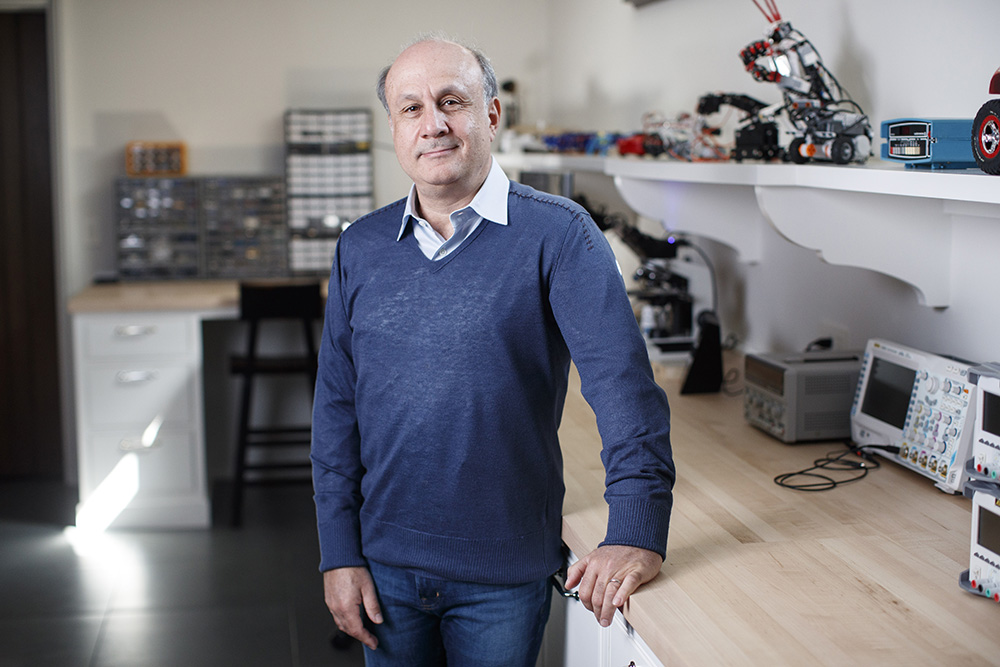
Computer scientist, entrepreneur, and philanthropist will collaborate with the MIT Schwarzman College of Computing to advance AI and scientific discovery.