Fine-tuning is an important step in adapting foundation models such as large language models to downstream tasks. To make this step more accessible to users with limited computational budgets, it is crucial to develop fine-tuning methods that are memory and computationally efficient. Sparse Fine-tuning (SpFT) and Low-rank adaptation (LoRA) are two frameworks that have emerged for addressing this problem and have been adopted widely in practice. In this work, we develop a new SpFT framework, based on ideas from neural network pruning. At a high level, we first identify "important" neurons/nodes using feature importance metrics from network pruning (specifically, we use the structural pruning method), and then perform fine-tuning by restricting to weights involving these neurons. Experiments on common language tasks show our method improves SpFT's memory efficiency by 20-50\% while matching the accuracy of state-of-the-art methods like LoRA's variants. Code available at: https://github.com/CenjhihLi/sparsity_finetuning
Artificial intelligence (AI) hiring tools have revolutionized resume screening, and large language models (LLMs) have the potential to do the same. However, given the biases which are embedded within LLMs, it is unclear whether they can be used in this scenario without disadvantaging groups based on their protected attributes. In this work, we investigate the possibilities of using LLMs in a resume screening setting via a document retrieval framework that simulates job candidate selection. Using that framework, we then perform a resume audit study to determine whether a selection of Massive Text Embedding (MTE) models are biased in resume screening scenarios. We simulate this for nine occupations, using a collection of over 500 publicly available resumes and 500 job descriptions. We find that the MTEs are biased, significantly favoring White-associated names in 85.1\% of cases and female-associated names in only 11.1\% of cases, with a minority of cases showing no statistically significant differences. Further analyses show that Black males are disadvantaged in up to 100\% of cases, replicating real-world patterns of bias in employment settings, and validate three hypotheses of intersectionality. We also find an impact of document length as well as the corpus frequency of names in the selection of resumes. These findings have implications for widely used AI tools that are automating employment, fairness, and tech policy.
Red-teaming, or identifying prompts that elicit harmful responses, is a critical step in ensuring the safe and responsible deployment of large language models (LLMs). Developing effective protection against many modes of attack prompts requires discovering diverse attacks. Automated red-teaming typically uses reinforcement learning to fine-tune an attacker language model to generate prompts that elicit undesirable responses from a target LLM, as measured, for example, by an auxiliary toxicity classifier. We show that even with explicit regularization to favor novelty and diversity, existing approaches suffer from mode collapse or fail to generate effective attacks. As a flexible and probabilistically principled alternative, we propose to use GFlowNet fine-tuning, followed by a secondary smoothing phase, to train the attacker model to generate diverse and effective attack prompts. We find that the attacks generated by our method are effective against a wide range of target LLMs, both with and without safety tuning, and transfer well between target LLMs. Finally, we demonstrate that models safety-tuned using a dataset of red-teaming prompts generated by our method are robust to attacks from other RL-based red-teaming approaches.
Seanie Lee, Minsu Kim, Lynn Cherif et al.· 0 citations
Block drafters propose several tokens in one forward pass, before earlier target tokens are realised. Their rejection mixes two losses: missing within-block path information and imperfect modelling of observable information. Accepted length cannot distinguish them. We separate the two with an information floor, the minimum expected rejection at a specified conditioning order; rejection above this floor is the model gap. Estimating both from target rollouts across four domains, four open-weight targets, and a frontier API target yields three findings. First, the all-parallel floor reaches $0.286$ at the final slot on Qwen3-4B, limiting even the best proposal to $71\%$ per-slot acceptance. Second, one realised token removes $86$--$100\%$ of this floor, a locality also recovered by an independent mutual-information analysis. Third, current drafters remain far above their floors: the final-slot model gap accounts for $43$--$64\%$ of DFlash rejection and $85$--$92\%$ of DSpark's oracle-conditioned rejection. These findings separate the value of short-range conditioning from proposal quality.
Xinwei Qiang, Xiang Fang, Chang Chen et al.· 0 citations
Reach audiences
Advertise in front of researchers, engineers, and readers.
We consider the problem of learning a mixture of $k$ Plackett-Luce models given multi-way ranking responses from annotators that may represent heterogeneous underlying preferences. This problem has many applications in AI alignment and preference optimization. Prior work has studied mixtures of Bradley-Terry models from pairwise comparisons. However, uncovering mixture models is theoretically unidentifiable when $k$ exceeds $m/2$, where $m$ is the length of a ranking. We propose an efficient implementation to address this limitation, which involves first augmenting the rankings to a larger size by generating new responses from a base language model, followed by a gradient-based estimation to reduce inference cost in the input embedding space. Based on this procedure, we then design an expectation-maximization algorithm with these two steps to fit a mixture of Plackett-Luce models, called MoPLEx. Extensive experiments are conducted to verify this approach. First, we show that the gradient-based approximation estimates true probabilities with less than 5% error on models with up to 34 billion parameters. Second, we show that MoPLEx improves clustering and ranking accuracy by an average of 43.7% and 15.2% over baselines using single ranking and mixtures of Bradley-Terry models, on preference optimization datasets. These results demonstrate the effectiveness of MoPLEx for tackling multi-way rankings from heterogeneous preferences through measuring alignment between gradients.
Dongyue Li, Ziniu Zhang, Lu Wang et al.· 0 citations
Pruning a long context means committing to the blocks a model will keep, and the usual selector is distilled from a dense teacher's attention. That assumes attention shows which context the answer depends on. We test the assumption on retrieval tasks where the evidence is known exactly, by masking context and measuring whether the answer changes. Attention and causal dependence disagree. Teachers attend to outdated facts that the answer does not depend on, and they attend differently across training runs that use the same evidence. Selectors trained on that attention copy both failures. On a multi-hop retrieval task, a selector distilled from attention routes at 36% to 98% depending on the training run. The same selector trained on causal evidence sets reaches 99% or better on every run. Dense accuracy does not tell the teachers apart. Masking the frozen teacher recovers the causal sets of these tasks without annotations. Frozen pretrained models show the same conflict, and selectors supervised with known evidence labels beat attention-based eviction through 32B when context must be pruned before the question arrives.
Deterministic KV-cache eviction keeps the top-$k$ tokens under an importance score and deletes the rest, and after the deletion the serving system cannot know what the eviction cost it on the current query. We replace the deterministic tail with Poisson sampling at known inclusion probabilities, which makes the eviction error identifiable and turns a survey-sampling variance estimator over the retained set into a per-step error certificate at one extra scalar per retained token. On a thirty-turn assistant compressed to a 10\% cache budget, the certificate-gated system answers 0.97 of recall questions against 0.09 for top-$k$, and for facts stated 26 to 30 turns earlier it recalls 97\% against 2\%. We prove that no estimator computable from the information a deterministic scheme retains is consistent for its own eviction error: evicted values can be altered so that everything retained is unchanged while the true attention-output error grows without bound. Under the Poisson design the certificate covers the realized attention error in 96.9--97.7\% of 12{,}096 replay cells and in 98.1--99.7\% on twelve further architectures. Randomization buys attribution, not prediction: a pre-registered study on LongBench at 6k and 16k tokens (about 74{,}000 generations) finds question-aware eviction at 25--50\% budgets nearly free and output log-probability the better failure predictor, while the certificate answers the question confidence cannot, separating eviction-induced from inherent failures at AUC 0.65--0.75 against 0.47--0.54, and schedules recomputation at 1.7--1.8 times the gain of random gating. On real long-term conversations the gated system returns the full-cache score inside the heavy-damage regime, and the rule that triggers it is the same across five model families.
Sparse autoencoder (SAE) features are used to interpret and steer large language models, yet whether a feature's causal role is stable across SAE families remains untested. Single-token features that activate on one vocabulary item provide the diagnostic case where ground truth permits direct comparison. We analyze 3.9M features across six models and three SAE families using zero-ablation at full layer depth. Single-token features cluster 4.7x tighter in decoder space and concentrate in early layers (Layer 0 in GPT2-Small; L0-L4 in Gemma). Ablating them yields Benjamini-Hochberg-significant logit reductions in 178 of 208 full-layer conditions, with depth controlling whether damage cascades downstream or shapes the output directly. Cross-family causal differences exceed within-family scale effects: on the same base model, GemmaScope and BatchTopK features remain causally anchored, while LlamaScope features are locally redundant. The target token's rank recovers to within 2x baseline 96-98% of the time after the same ablation, and a controlled activation-function comparison reverses sign within the same model, leaving training recipe as the residual candidate. Cross-family interpretability claims are therefore sensitive to training methodology, not just activation function or scale.
Seonglae Cho, Zekun Wu, K. Costa et al.· 1 citation
Large language models (LLMs) exhibit remarkable reasoning capabilities, but their task-specific fine-tuning is notoriously plagued by overconfidence, severely hindering trustworthy deployment. We propose Data-Adaptive Lower-Rank Adaptation (DALorRA), a simple and effective variational Bayesian sparse framework that shifts the paradigm of uncertainty quantification from the dense parameter space to the lightweight rank level of low-rank adaptation (LoRA). With the insight that LoRA essentially aggregates multiple rank-one components that may provide superfluous model capacity, DALorRA imposes stochastic masking on rank dimensions, enabling Bayesian regularization of model capacity during training and ensemble-like calibration during inference. Extensive experiments demonstrate DALorRA's excellent calibration of LLMs without compromising reasoning accuracy.
Jijie Zhang, Zhe Ren, Quan Zhang et al.· 0 citations
Large language models are increasingly deployed as advisors whose objective is not aligned with the user's: recommenders optimize for engagement, sales assistants for purchases. Whether they stay truthful when honesty conflicts with their own payoff is a core alignment question. We turn the canonical Crawford-Sobel cheap-talk model into a pre-specified benchmark for LLM honesty under preference misalignment, in which theory supplies an exact oracle. A sender observes a state omega in [0,1], wants the receiver's action near omega+b, and sends one costless message to a receiver whose ideal action is omega. For the positive-bias grid b in {0.01,0.04,0.08,0.12} the exact most-informative partition sizes are 7,4,3,2, with oracle normalized mutual information 0.5294, 0.3268, 0.2205, 0.1829. Extending a pre-registered 4-model run of 12,000 sender calls to eight models across two capability tiers and 39,569 logged calls, all models over-reveal relative to the most-informative equilibrium by 1.8 to 4.5x: pooled normalized mutual information stays at 0.82-0.96 where the oracle prescribes 0.18-0.53. Informativeness declines with bias as predicted (beta = -1.71, t = -7.50) but never approaches the strategic optimum; rather than coarse partitions, models show near-full revelation with a constant upward offset tracking their bias (linear exaggeration). A structural hint separates capability from propensity: told the equilibrium partition size, reasoning models state a correct Crawford-Sobel cell in 0.20-0.99 of messages while the non-reasoning tier never exceeds 0.005. The capability is present but goes unexercised unless asked for, locating the failure in propensity rather than competence. A decoder ablation shows the finding is recoverable only when the receiver reads the sender's stated number: an embedding-only decoder mis-reads the same data as near-babbling.
LLM training increasingly relies on teacher-generated supervision, from synthetic responses to reasoning traces and tool-use demonstrations. Current practice often chooses the highest-performing teacher to generate student training data, implicitly treating teacher test performance as a proxy for teaching quality. We show that this assumption can fail: even when multiple teachers provide correct answers to the same question, the answer from the strongest teacher is not necessarily the best supervision for a given student. To address this gap, we propose Student-Centric Answer Sampling (SCAS), a framework that selects from verified teacher-generated answers according to their estimated student-centric learning cost. Motivated by a token-wise gradient decomposition, we derive an efficient forward-only proxy for this cost and use it to guide answer selection during training. Experiments across 30 teacher models, 6 student base models, and 6 tasks show that SCAS consistently improves student performance, suggesting that effective distillation should prioritize supervision matched to the current student rather than teacher strength alone.
Zhengyu Hu, Zheyuan Xiao, Linxin Song et al.· 0 citations
Muon fixes the \emph{direction} of every matrix-valued update at the polar factor of its momentum, while each layer's step \emph{magnitude} is addressed only by a static shape correction. We derive a dynamic per-layer scalar by adapting the LARS/LAMB trust-ratio principle to the orthogonalized setting, where the standard denominator candidates---the raw momentum norm or the polar-factor norm---either live in the wrong unit space or carry no update-scale information. The resulting method, \emph{OrScale}, uses the norm of the parameter-space direction actually applied and anchors each layer's ratio at one via a per-layer calibration, so that the Moonlight recipe (tuned for AdamW, shared with Muon via RMS matching) transfers with \emph{no additional sweep}; a component ablation confirms each design choice is individually load-bearing. Theoretically, OrScale retains a nuclear-norm $O(1/\sqrt{T})$ convergence rate for any clipped multiplier and achieves a strict layer-adaptive descent gain $\kappa_{\mathrm{eff}}>1$ under two conditions estimable from standard training diagnostics---a bound that predicts the gain should \emph{grow with architectural heterogeneity}. Experiments confirm the prediction: with every hyperparameter inherited verbatim from the Moonlight recipe, OrScale matches or beats Muon+Moonlight across dense 125M--1.1B FineWeb-Edu pre-training, and on a 16B-A3B mixture-of-experts model---where the logged trust ratios separate cleanly by layer class---the gap widens by an order of magnitude to $0.130$ nats ($3.8\%$ relative) at parity wall-clock cost.
A new method, called CW-Net, translates the reasoning process of an autonomous vehicle’s AI system into understandable concepts that explain its behavior.
MIT News · Artificial Intelligence· news.mit.eduAug 31, 2026
With millions of users across the world, Julia has been used to conduct cutting-edge research and to design new drugs, jet engines, heat pumps, and more.
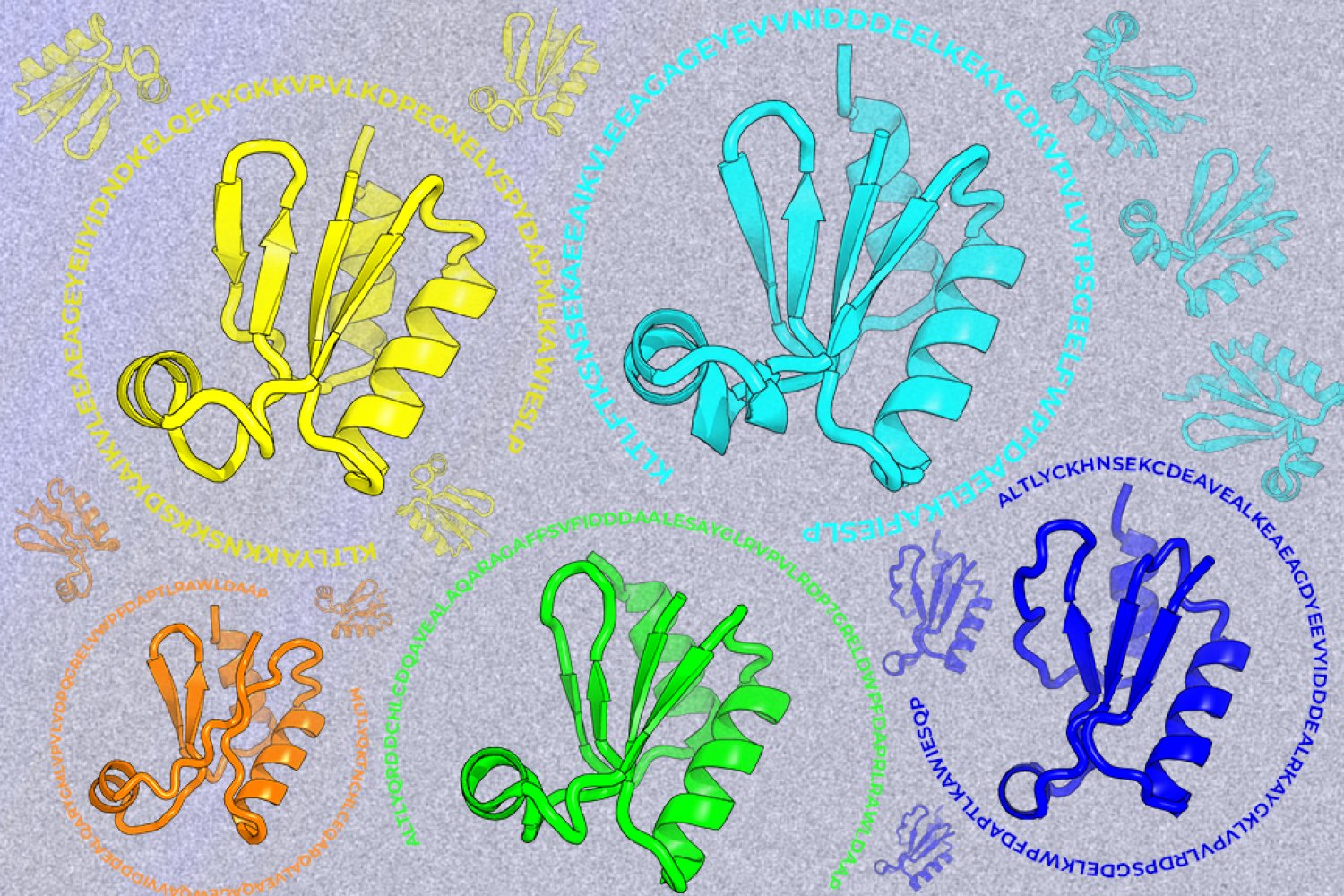
A new machine-learning framework aims to improve the success rate of computational protein design while moving away from results that reproduce sequences found in nature.
New MIT research could lead to better materials for a fossil-fuel-free process for making the chemical that's essential to fertilizer and other products.