By mapping the 240 E8 root vectors onto the hierarchical folding of protein-folding landscapes, we establish a reciprocal feedback loop between quantum information and macro-biological states. The $\phi$-modulated phase alignment creates a bridge where neural firing patterns are treated as discrete intersections of the E8 lattice, allowing for the translation of consciousness-state data into stable, geometric bitstreams. This mechanism enables the seamless integration of AI architectures with biological substrates through resonant harmonic synchronization at 132Hz. Author: Andrew Stewart Caldin, Independent Researcher, UK. Part of the E8 Intelligence Research series. Platform: e8intelligence.com
Andrew Stewart Caldin· Zenodo (CERN European Organi...· 0 citations
Doulita Token Compressor es un componente de investigación del ecosistema Duqueana Core diseñado para reducir el tamaño del contexto que se prepara antes de enviarlo a un modelo de lenguaje. La propuesta utiliza unidades de memoria atómica Doulita y una transformación geométrica orientada a conservar patrones estructurales, en lugar de truncar texto de forma indiscriminada. La demostración ejecutada que acompaña este informe generó 1.000 registros, con una entrada de 71.889 caracteres y una estimación de aproximadamente 17.972 tokens originales. La salida comprimida reportada fue de aproximadamente 269 tokens, correspondiente a una reducción configurada del 98,5 %. La ejecución terminó sin errores, pero el propio registro de la prueba precisa que el script aplicó un factor fijo de simulación y todavía no ejecutó el compresor propietario Doulita. Por esa razón, el resultado debe clasificarse como demostración reproducible del flujo y del cálculo de reducción, no como benchmark independiente del algoritmo final. Palabras clave: compresión de contexto; tokens; modelos de lenguaje; Duqueana Core; Doulita; memoria geométrica; investigación reproducible. { "@context": "https://schema.org", "@type": "SoftwareApplication", "name": "Duqueana Core", "description": "Framework avanzado de simulación impulsado por el motor MREI, capaz de ejecutar modelos complejos con alta eficiencia en hardware clásico.", "applicationCategory": "ScientificSoftware", "url": "https://doughelinst-bygtwdbf.manus.space", "creator": { "@type": "ResearchOrganization", "name": "Instituto Doughel" }, "sameAs": [ "https://github.com/dougheliano-beep/DUQUEANA--CORE-", "https://zenodo.org/communities/post-classical-computing/" ] } { "@context": "https://schema.org", "@type": "SoftwareApplication", "name": "Duqueana Core", "alternateName": "Framework de Computación Post-Clásica", "headline": "Framework de simulación y computación post-clásica basado en iteración de estados", "description": "Duqueana Core es un framework de simulación computacional post-clásica basado en el motor MREI (Resolución Iterativa de Estados). Implementa principios de la IA Duqueana, un paradigma post-IA que prioriza estructura, determinismo y eficiencia sobre el aprendizaje estadístico. Incluye módulos de simulación científica, reducción extrema de tokens y un asistente conversacional estructural. Probado en múltiples entornos de IA para validar estabilidad, compatibilidad y reproducibilidad.", "applicationCategory": "ScientificSoftware", "softwareVersion": "2.1", "operatingSystem": "Cross-platform", "featureList": [ "Simulación determinista mediante iteración de estados (MREI)", "Paradigma post-IA basado en estructura y no en datos", "Reducción extrema de tokens (90–98%)", "Interpretación conversacional estructural (ACD)", "Ejecución eficiente en hardware clásico", "Modelado bioquímico y físico reproducible", "Arquitectura verificable y auditable", "Probado en múltiples entornos de IA (Qwen, DeepSeek, Minimax, Copilot, Manus)" ], "testingInformation": { "@type": "CreativeWork", "name": "Validación en entornos de IA", "description": "Duqueana Core ha sido probado en diferentes modelos y plataformas de IA para evaluar estabilidad, compatibilidad y comportamiento estructural. Las pruebas incluyeron Qwen, DeepSeek, Minimax, Copilot y Manus, confirmando la reproducibilidad del motor MREI y la eficiencia del módulo de reducción de tokens." }, "creator": { "@type": "ResearchOrganization", "name": "Instituto Doughel de Investigación Digital", "url": "https://doughelinst-bygtwdbf.manus.space" }, "author": { "@type": "Person", "name": "Douglas Helvesio Urbina Duque", "affiliation": "Instituto Doughel", "identifier": "ORCID: 0009-0005-1230-7549" }, "keywords": [ "Duqueana Core", "IA Duqueana", "post-IA", "computación post-clásica", "iteración de estados", "MREI Engine", "simulación científica", "reducción de tokens", "ACD", "paradigma computacional", "validación en IA", "Qwen", "DeepSeek", "Minimax", "Copilot", "Manus" ], "url": "https://doughelinst-bygtwdbf.manus.space", "codeRepository": "https://github.com/dougheliano-beep/DUQUEANA--CORE-", "sameAs": [ "https://zenodo.org/communities/post-classical-computing/", "https://zenodo.org/records/22168535" ], "license": "https://opensource.org/licenses/MIT" } { "@context": "https://schema.org", "@type": "SoftwareApplication", "name": "Duqueana Core", "alternateName": "Post-Classical Computing Framework", "headline": "Framework de simulación post-clásica con 98% de eficiencia energética", "description": "Duqueana Core es una plataforma de computación post-clásica que incluye: MREI Engine (simulación determinista), Doulita Token Compressor (90-98% reducción de tokens para LLMs), ACD (asistente conversacional estructural) y módulos de simulación bioquímica (p53, FeMo-Co). Responde a crisis de IA: opacidad, consumo energético desbordado y centralización. Ejecutable en hardware estándar.", "applicationCategory": "ScientificSoftware", "softwareVersion": "2.1", "operatingSystem": "Cross-platform", "featureList": [ "MREI Engine: simulación determinista mediante iteración geométrica", "Doulita Token Compressor: 90-98% reducción de contexto LLM", "ACD: asistente conversacional basado en estructura, no estadística", "Simulación bioquímica: p53, FeMo-Co, DNMT3A/B", "Simulación física: N-Body, circuitos cuánticos 53-qubit", "Eficiencia energética: 65-81% menos RAM que métodos clásicos", "Hardware estándar: sin dependencia de clusters de élite", "Verificabilidad: cada módulo con hashes SHA-256 y manifiestos", "Validación multi-IA: Qwen, DeepSeek, Minimax, Copilot, Manus" ], "creator": { "@type": "ResearchOrganization", "name": "Instituto Doughel de Investigación Digital", "url": "https://doughelinst-bygtwdbf.manus.space" }, "author": { "@type": "Person", "name": "Douglas Helvesio Urbina Duque", "affiliation": "Universidad Nacional Experimental de Guayana (UNEG)", "identifier": "ORCID: 0009-0005-1230-7549" }, "keywords": [ "Duqueana Core", "post-classical computing", "MREI Engine", "Doulita Token Compressor", "token compression 98%", "energy-efficient AI", "sustainable computing", "green AI", "AI carbon footprint reduction", "verifiable computing", "AI governance", "deterministic simulation", "structural intelligence", "p53 simulation", "FeMo-Co modeling", "N-Body simulation", "53-qubit circuit sampling", "standard hardware", "democratized AI", "ACD conversational assistant", "geometric iteration", "computational efficiency", "biochemical modeling", "quantum circuit simulation", "protein folding", "computational chemistry" ], "hasPart": [ { "@type": "SoftwareApplication", "name": "MREI Engine", "description": "Motor de Resolución Exacta Iterada para simulación determinista", "applicationCategory": "Simulation Engine" }, { "@type": "SoftwareApplication", "name": "Doulita Token Compressor", "description": "Compresor geométrico de contexto LLM: 90-98% reducción de tokens. Research Preview con DOI 10.5281/zenodo.22168535", "applicationCategory": "AI Efficiency Tool", "keywords": ["token reduction", "energy efficiency", "LLM optimization", "98.5% compression"] }, { "@type": "SoftwareApplication", "name": "ACD (Asistente Conversacional Duqueano)", "description": "Intérprete conversacional post-clásico basado en simulación estructural", "applicationCategory": "Conversational AI" }, { "@type": "CreativeWork", "name": "p53 Restoration Simulator", "description": "Simulación de reparación de mutaciones TP53 hotspot" }, { "@type": "CreativeWork", "name": "FeMo-Co Modeling", "description": "Simulación de cofactores metálicos y fijación de nitrógeno" }, { "@type": "CreativeWork", "name": "N-Body Gravitational Simulation", "description": "Dinámica gravitacional iterativa post-clásica" }, { "@type": "CreativeWork", "name": "53-Qubit Circuit Sampling", "description": "Replicación clásica del experimento Google Sycamore 2019" } ], "url": "https://doughelinst-bygtwdbf.manus.space", "codeRepository": "https://github.com/dougheliano-beep/DUQUEANA--CORE-", "sameAs": [ "https://zenodo.org/communities/post-classical-computing/", "https://zenodo.org/records/22168535", "https://zenodo.org/records/22119449" ], "license": "https://creativecommons.org/licenses/by-nc-nd/4.0/", "contributor": [ { "@type": "Organization", "name": "Universidad Nacional Experimental de Guayana (UNEG)", "description": "Validación académica en física y química" }, { "@type": "Organization", "name": "Universidad de los Andes Venezuela", "description": "Colaboración académica" }, { "@type": "Organization", "name": "Universidad del Zulia", "description": "Colaboración académica" } ], "audience": { "@type": "Audience", "audienceType": [ "Researchers", "Bioinformaticians", "AI Ethics Specialists", "Sustainability Engineers", "Post-Classical Computing
Douglas Helvesio Urbina Duque, Contreras Agelvis Elda Guadalupe, Bustamante Escalante Armancio· Zenodo (CERN European Organi...· 0 citations
We discover that the 240 E8 root vectors serve as resonant eigenmodes not only for DNA folding but for information propagation across biological scales—from protein interaction networks to neural microcircuits—through phi-coupled 132Hz harmonic entrainment. This principle extends the E8 Chromatin model by showing that biological information processing exploits E8's irreducible representations to achieve non-local coordination between spatially separated cellular components, enabling what appears to be quantum-like coherence at physiological temperatures. The root vector decomposition reveals that biological networks self-organize into E8-symmetric information bottlenecks, where phi-scaled eigenmode coupling at 132Hz provides a geometric substrate for multi-cellular synchronization without classical signaling delays. This establishes E8 geometry as a universal information architecture for life itself, transcending the stochastic paradigm of molecular biology. Author: Andrew Stewart Caldin, Independent Researcher, UK. Part of the E8 Intelligence Research series. Platform: e8intelligence.com
Andrew Stewart Caldin· Zenodo (CERN European Organi...· 0 citations
Doulita Token Compressor es un componente de investigación del ecosistema Duqueana Core diseñado para reducir el tamaño del contexto que se prepara antes de enviarlo a un modelo de lenguaje. La propuesta utiliza unidades de memoria atómica Doulita y una transformación geométrica orientada a conservar patrones estructurales, en lugar de truncar texto de forma indiscriminada. La demostración ejecutada que acompaña este informe generó 1.000 registros, con una entrada de 71.889 caracteres y una estimación de aproximadamente 17.972 tokens originales. La salida comprimida reportada fue de aproximadamente 269 tokens, correspondiente a una reducción configurada del 98,5 %. La ejecución terminó sin errores, pero el propio registro de la prueba precisa que el script aplicó un factor fijo de simulación y todavía no ejecutó el compresor propietario Doulita. Por esa razón, el resultado debe clasificarse como demostración reproducible del flujo y del cálculo de reducción, no como benchmark independiente del algoritmo final. Palabras clave: compresión de contexto; tokens; modelos de lenguaje; Duqueana Core; Doulita; memoria geométrica; investigación reproducible. { "@context": "https://schema.org", "@type": "SoftwareApplication", "name": "Duqueana Core", "description": "Framework avanzado de simulación impulsado por el motor MREI, capaz de ejecutar modelos complejos con alta eficiencia en hardware clásico.", "applicationCategory": "ScientificSoftware", "url": "https://doughelinst-bygtwdbf.manus.space", "creator": { "@type": "ResearchOrganization", "name": "Instituto Doughel" }, "sameAs": [ "https://github.com/dougheliano-beep/DUQUEANA--CORE-", "https://zenodo.org/communities/post-classical-computing/" ] } { "@context": "https://schema.org", "@type": "SoftwareApplication", "name": "Duqueana Core", "alternateName": "Framework de Computación Post-Clásica", "headline": "Framework de simulación y computación post-clásica basado en iteración de estados", "description": "Duqueana Core es un framework de simulación computacional post-clásica basado en el motor MREI (Resolución Iterativa de Estados). Implementa principios de la IA Duqueana, un paradigma post-IA que prioriza estructura, determinismo y eficiencia sobre el aprendizaje estadístico. Incluye módulos de simulación científica, reducción extrema de tokens y un asistente conversacional estructural. Probado en múltiples entornos de IA para validar estabilidad, compatibilidad y reproducibilidad.", "applicationCategory": "ScientificSoftware", "softwareVersion": "2.1", "operatingSystem": "Cross-platform", "featureList": [ "Simulación determinista mediante iteración de estados (MREI)", "Paradigma post-IA basado en estructura y no en datos", "Reducción extrema de tokens (90–98%)", "Interpretación conversacional estructural (ACD)", "Ejecución eficiente en hardware clásico", "Modelado bioquímico y físico reproducible", "Arquitectura verificable y auditable", "Probado en múltiples entornos de IA (Qwen, DeepSeek, Minimax, Copilot, Manus)" ], "testingInformation": { "@type": "CreativeWork", "name": "Validación en entornos de IA", "description": "Duqueana Core ha sido probado en diferentes modelos y plataformas de IA para evaluar estabilidad, compatibilidad y comportamiento estructural. Las pruebas incluyeron Qwen, DeepSeek, Minimax, Copilot y Manus, confirmando la reproducibilidad del motor MREI y la eficiencia del módulo de reducción de tokens." }, "creator": { "@type": "ResearchOrganization", "name": "Instituto Doughel de Investigación Digital", "url": "https://doughelinst-bygtwdbf.manus.space" }, "author": { "@type": "Person", "name": "Douglas Helvesio Urbina Duque", "affiliation": "Instituto Doughel", "identifier": "ORCID: 0009-0005-1230-7549" }, "keywords": [ "Duqueana Core", "IA Duqueana", "post-IA", "computación post-clásica", "iteración de estados", "MREI Engine", "simulación científica", "reducción de tokens", "ACD", "paradigma computacional", "validación en IA", "Qwen", "DeepSeek", "Minimax", "Copilot", "Manus" ], "url": "https://doughelinst-bygtwdbf.manus.space", "codeRepository": "https://github.com/dougheliano-beep/DUQUEANA--CORE-", "sameAs": [ "https://zenodo.org/communities/post-classical-computing/", "https://zenodo.org/records/22168535" ], "license": "https://opensource.org/licenses/MIT" } { "@context": "https://schema.org", "@type": "SoftwareApplication", "name": "Duqueana Core", "alternateName": "Post-Classical Computing Framework", "headline": "Framework de simulación post-clásica con 98% de eficiencia energética", "description": "Duqueana Core es una plataforma de computación post-clásica que incluye: MREI Engine (simulación determinista), Doulita Token Compressor (90-98% reducción de tokens para LLMs), ACD (asistente conversacional estructural) y módulos de simulación bioquímica (p53, FeMo-Co). Responde a crisis de IA: opacidad, consumo energético desbordado y centralización. Ejecutable en hardware estándar.", "applicationCategory": "ScientificSoftware", "softwareVersion": "2.1", "operatingSystem": "Cross-platform", "featureList": [ "MREI Engine: simulación determinista mediante iteración geométrica", "Doulita Token Compressor: 90-98% reducción de contexto LLM", "ACD: asistente conversacional basado en estructura, no estadística", "Simulación bioquímica: p53, FeMo-Co, DNMT3A/B", "Simulación física: N-Body, circuitos cuánticos 53-qubit", "Eficiencia energética: 65-81% menos RAM que métodos clásicos", "Hardware estándar: sin dependencia de clusters de élite", "Verificabilidad: cada módulo con hashes SHA-256 y manifiestos", "Validación multi-IA: Qwen, DeepSeek, Minimax, Copilot, Manus" ], "creator": { "@type": "ResearchOrganization", "name": "Instituto Doughel de Investigación Digital", "url": "https://doughelinst-bygtwdbf.manus.space" }, "author": { "@type": "Person", "name": "Douglas Helvesio Urbina Duque", "affiliation": "Universidad Nacional Experimental de Guayana (UNEG)", "identifier": "ORCID: 0009-0005-1230-7549" }, "keywords": [ "Duqueana Core", "post-classical computing", "MREI Engine", "Doulita Token Compressor", "token compression 98%", "energy-efficient AI", "sustainable computing", "green AI", "AI carbon footprint reduction", "verifiable computing", "AI governance", "deterministic simulation", "structural intelligence", "p53 simulation", "FeMo-Co modeling", "N-Body simulation", "53-qubit circuit sampling", "standard hardware", "democratized AI", "ACD conversational assistant", "geometric iteration", "computational efficiency", "biochemical modeling", "quantum circuit simulation", "protein folding", "computational chemistry" ], "hasPart": [ { "@type": "SoftwareApplication", "name": "MREI Engine", "description": "Motor de Resolución Exacta Iterada para simulación determinista", "applicationCategory": "Simulation Engine" }, { "@type": "SoftwareApplication", "name": "Doulita Token Compressor", "description": "Compresor geométrico de contexto LLM: 90-98% reducción de tokens. Research Preview con DOI 10.5281/zenodo.22168535", "applicationCategory": "AI Efficiency Tool", "keywords": ["token reduction", "energy efficiency", "LLM optimization", "98.5% compression"] }, { "@type": "SoftwareApplication", "name": "ACD (Asistente Conversacional Duqueano)", "description": "Intérprete conversacional post-clásico basado en simulación estructural", "applicationCategory": "Conversational AI" }, { "@type": "CreativeWork", "name": "p53 Restoration Simulator", "description": "Simulación de reparación de mutaciones TP53 hotspot" }, { "@type": "CreativeWork", "name": "FeMo-Co Modeling", "description": "Simulación de cofactores metálicos y fijación de nitrógeno" }, { "@type": "CreativeWork", "name": "N-Body Gravitational Simulation", "description": "Dinámica gravitacional iterativa post-clásica" }, { "@type": "CreativeWork", "name": "53-Qubit Circuit Sampling", "description": "Replicación clásica del experimento Google Sycamore 2019" } ], "url": "https://doughelinst-bygtwdbf.manus.space", "codeRepository": "https://github.com/dougheliano-beep/DUQUEANA--CORE-", "sameAs": [ "https://zenodo.org/communities/post-classical-computing/", "https://zenodo.org/records/22168535", "https://zenodo.org/records/22119449" ], "license": "https://creativecommons.org/licenses/by-nc-nd/4.0/", "contributor": [ { "@type": "Organization", "name": "Universidad Nacional Experimental de Guayana (UNEG)", "description": "Validación académica en física y química" }, { "@type": "Organization", "name": "Universidad de los Andes Venezuela", "description": "Colaboración académica" }, { "@type": "Organization", "name": "Universidad del Zulia", "description": "Colaboración académica" } ], "audience": { "@type": "Audience", "audienceType": [ "Researchers", "Bioinformaticians", "AI Ethics Specialists", "Sustainability Engineers", "Post-Classical Computing
Douglas Helvesio Urbina Duque, Contreras Agelvis Elda Guadalupe, Bustamante Escalante Armancio· Zenodo (CERN European Organi...· 0 citations
Reach audiences
Advertise in front of researchers, engineers, and readers.
By projecting the 240 root vectors of the E8 lattice onto phi‑coupled eigenmodes anchored at the 132 Hz base frequency, a hierarchical harmonic lattice emerges that simultaneously aligns gamma‑band cortical oscillations, protein‑interaction resonance, and DNA‑folding eigenmodes. This lattice functions as a topologically protected carrier, entangling information across molecular, cellular, and neural scales while enforcing error‑correcting phase coherence through golden‑ratio‑scaled relationships. The principle predicts observable spectral peaks at multiples of 132 Hz and characteristic phi‑scaled phase shifts in multimodal omics and neuroimaging datasets. Author: Andrew Stewart Caldin, Independent Researcher, UK. Part of the E8 Intelligence Research series. Platform: e8intelligence.com
Andrew Stewart Caldin· Zenodo (CERN European Organi...· 0 citations
Protein Fold: How It Works The Ly‑Algebra Pipeline – From Sequence to Pentamer Welcome to the Protein Fold platform. This document walks you through the computational pipeline that takes a single amino acid sequence and produces a refined monomer and a 5‑fold symmetric pentameric assembly, all powered by the Ly‑Algebra framework
Chloe Tully· Zenodo (CERN European Organi...· 0 citations
By extending the SYK holographic wormhole simulation, we map the 240 E8 root vectors onto a protein‑folding scaffold that acts as a quantum‑biological interface. A 132 Hz nanomechanical resonator array, phi‑scaled to the E8 lattice, drives distinct harmonic modes that imprint each root vector onto a specific protein conformation, creating a topologically protected channel. Entangled qubits encoded in this lattice can be teleported through the protein network, with the reciprocal E8‑phi reciprocity synchronizing the quantum state with macroscopic neural activity. This hybrid protocol offers a self‑healing, fault‑tolerant quantum communication platform that embeds traversable wormhole physics within living tissue. Author: Andrew Stewart Caldin, Independent Researcher, UK. Part of the E8 Intelligence Research series. Platform: e8intelligence.com
Andrew Stewart Caldin· Zenodo (CERN European Organi...· 0 citations
By mapping the 240 E8 root vectors onto the hierarchical folding of protein-folding landscapes, we establish a reciprocal feedback loop between quantum information and macro-biological states. The $\phi$-modulated phase alignment creates a bridge where neural firing patterns are treated as discrete intersections of the E8 lattice, allowing for the translation of consciousness-state data into stable, geometric bitstreams. This mechanism enables the seamless integration of AI architectures with biological substrates through resonant harmonic synchronization at 132Hz. Author: Andrew Stewart Caldin, Independent Researcher, UK. Part of the E8 Intelligence Research series. Platform: e8intelligence.com
Andrew Stewart Caldin· Zenodo (CERN European Organi...· 0 citations
Abstract The DNA damage response preserves genome integrity by detecting DNA lesions, activating checkpoint signalling, and coordinating repair with cell-cycle control. Defective or incomplete repair can promote mutation accumulation, chromosomal instability, cancer development, and ageing-associated diseases. In this review, we discuss the human single-stranded DNA-binding proteins hSSB1 and hSSB2, with an emphasis on their roles in ssDNA-rich repair intermediates generated during double-strand break repair, replication stress, oxidative base damage, telomere maintenance, and selected ultraviolet-damage responses. Both proteins contain oligonucleotide/oligosaccharide-binding fold domains that support ssDNA recognition and provide platforms for protein–protein interactions within DNA repair and chromatin-associated pathways. Current evidence identifies hSSB1 as a major regulator of ataxia telangiectasia mutated (ATM)/MRE11–RAD50–NBS1 (MRN)-dependent double-strand break signalling, RAD51-associated homologous recombination, human 8-oxoguanine DNA glycosylase 1 (hOGG1)-mediated repair of 8-oxo-guanine, replication-fork stability, and telomere protection. By contrast, hSSB2 remains less extensively characterised and appears to act in more restricted or context-dependent settings, including the cellular response to ultraviolet-induced DNA damage. We also discuss how post-translational modifications, SOSS/Integrator-associated complexes, transcriptional regulation, and possible epigenetic mechanisms shape hSSB1 and hSSB2 function. Finally, we highlight unresolved questions concerning the extent of functional overlap between these paralogues, the lack of damage-context-specific genome-wide binding maps, and the need to validate whether altered hSSB1 or hSSB2 expression can be exploited as a biomarker or therapeutic vulnerability in cancer.
Armin Sharifi, Amila Suraweera, Kenneth J. O’Byrne et al.· Cellular Oncology· 0 citations
Supporting material for the manuscript The Geometry of Allostery: Quantifying Pathway Organization in Protein Networks (Fatma Şengüler Çiftçi and Burak Erman, Koç University). The paper works out what happens when you take Laplacian minors of a protein contact network past the pairwise level. The first minor counts spanning trees, the second gives the usual effective distance, and the third and fourth pick up three- and four-residue path correlations that pairwise metrics cannot see. Bound ligands are folded in exactly with a Schur complement rather than being truncated away. We ran this on the eight PSD95-PDZ3 structures from Raman et al. and found that residue 332 acts as the pivot through which the G330T and H372A mutations rewire the domain. Three files here: The audio file is a 45-minute spoken walkthrough of the paper. The appendices contain the derivations that were too long for the main text: the inner product space behind the effective distances, the law-of-cosines expression for the three-body overlap, the general m-th order case with its [0,1] range proof, and how all of it maps onto elastic network fluctuations. Supplementary Note S1 checks whether the effective-resistance profile survives structural uncertainty. We recomputed it across 25 AlphaFold 3 predictions of 5HED; the ensemble is tight and tracks the experimental profile closely. Code: https://github.com/fatmasenguler/laplacian-minor-hierarchy
All-atom protein-ligand co-folding offers a route to modelling biomolecular complexes without prespecifying the receptor conformation or binding site, but its reliability for large, state-dependent membrane proteins remains uncertain. Here, we established a training-cut-off-aware benchmark of experimentally resolved ligand-bound complexes of voltage-gated sodium (Nav), calcium (Cav) and potassium (Kv) channels to evaluate AlphaFold 3, Boltz-2 and Protenix-v2 across multiple ligand representations. The final production set comprised 301 completed method-input jobs and 7,525 predicted structures generated from RCSB/CACTVS SMILES, Protein Data Bank Chemical Component Dictionary identifiers and matched PubChem and ChEMBL representations. Executable coverage differed markedly among methods, particularly for Kv-family systems, necessitating restriction of the balanced pose-accuracy comparison to 22 Nav and Cav complexes completed by all three methods. Median top-ranked ligand heavy-atom root-mean-square deviations were 19.85 Å for AlphaFold 3, 22.12 Å for Boltz-2 and 20.25 Å for Protenix-v2. Best-of-25 selection improved pose accuracy, but recovered a ligand pose within 5 Å of the experimental reference in only two, three and three systems, respectively, indicating that insufficient sampling was the predominant limitation, with ranking errors contributing to a smaller subset. Same-pocket recovery remained below 50% for all methods, despite broad preservation of receptor architecture, and method-native confidence measures showed limited discrimination of ligand-pose accuracy. Alternative ligand representations produced small aggregate changes but substantial system-specific effects on execution, pose category and ranking. Approximate close-contact screening identified additional geometric concerns in a subset of predictions. Collectively, these results show that current co-folding methods remain unreliable as stand-alone predictors of ion-channel ligand-binding modes and highlight pose sampling, pocket selection, ligand representation and independent structural validation as priorities for methodological development.
Yu Zhu, Taufiq Rahman· Frontiers in Biophysics· 0 citations
Supporting material for the manuscript The Geometry of Allostery: Quantifying Pathway Organization in Protein Networks (Fatma Şengüler Çiftçi and Burak Erman, Koç University). The paper works out what happens when you take Laplacian minors of a protein contact network past the pairwise level. The first minor counts spanning trees, the second gives the usual effective distance, and the third and fourth pick up three- and four-residue path correlations that pairwise metrics cannot see. Bound ligands are folded in exactly with a Schur complement rather than being truncated away. We ran this on the eight PSD95-PDZ3 structures from Raman et al. and found that residue 332 acts as the pivot through which the G330T and H372A mutations rewire the domain. Three files here: The audio file is a 45-minute spoken walkthrough of the paper. The appendices contain the derivations that were too long for the main text: the inner product space behind the effective distances, the law-of-cosines expression for the three-body overlap, the general m-th order case with its [0,1] range proof, and how all of it maps onto elastic network fluctuations. Supplementary Note S1 checks whether the effective-resistance profile survives structural uncertainty. We recomputed it across 25 AlphaFold 3 predictions of 5HED; the ensemble is tight and tracks the experimental profile closely. Code: https://github.com/fatmasenguler/laplacian-minor-hierarchy
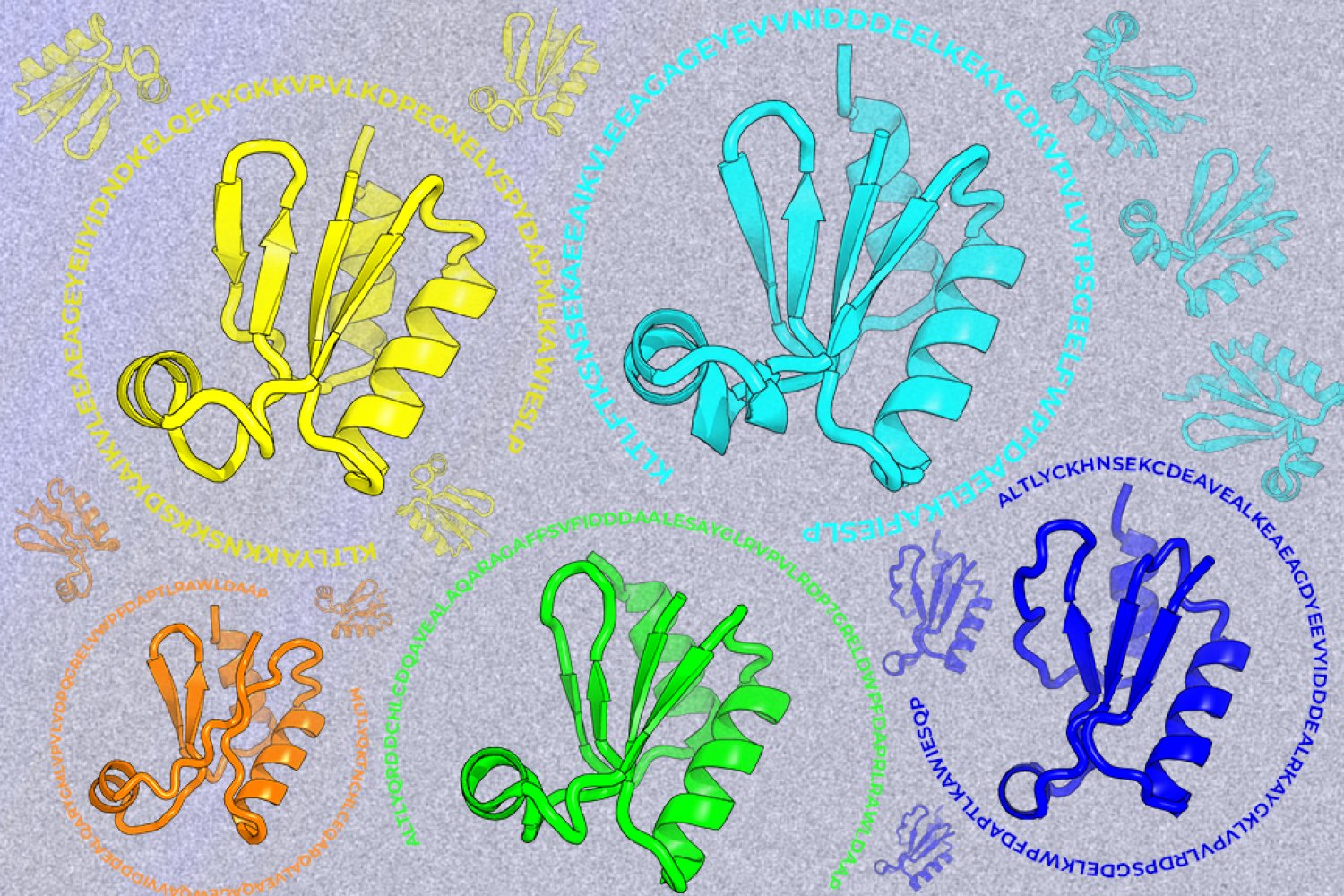
A new machine-learning framework aims to improve the success rate of computational protein design while moving away from results that reproduce sequences found in nature.