This article analyzes the flow-debt tradeoffs associated with VC and identifies and explains how current model, platform, and hardware limitations contribute to these issues, and proposes countermeasures to address them, informing research and practice towards more sustainable VC approaches.
Muhammad Waseem, Aakash Ahmad, Kai-Kristian Kemell et al.· arXiv.org· 4 citations
This is one of the first reviews to integrate peer-reviewed and grey literature on vibe coding under a single documented protocol and is strongest for prototyping and user-interface work and weakest for production, data-intensive, and safety-critical use, and tool visibility does not imply effectiveness.
Shahbaz Siddeeq, Muhammad Waseem, Kai-Kristian Kemell et al.· arXiv.org· 0 citations
An experience report from a small full-stack team that applied contextual prompting and explicit architectural constraints to build a multi-project agent learning platform designed for sustained, production-oriented use and an academic retrieval-augmented generation system is presented.
Md Nasir Uddin Shuvo, M. Islam, Mahade Hasan et al.· arXiv.org· 1 citation
Reach audiences
Advertise in front of researchers, engineers, and readers.
The use of large language models to automatically improve the user story quality in Austrian Post Group IT agile teams is explored, with a reference model for an Autonomous LLM-based Agent System developed and implemented at the company.
Zheying Zhang, M. Rayhan, Tomas Herda et al.· International Conference on...· 48 citations· ⚡4
The workshop culminated in the collaborative development of a research roadmap that pinpoints actionable directions for future work, including both immediate solutions and ambitious long-term goals.
Tomas Herda, Victoria Pichler, Zheying Zhang et al.· XP Workshops· 3 citations
Results highlight the ability of LLM-based multi-agent in managing refactoring tasks targeted toward functional programming paradigms and hint that LLM-based multi-agent systems integration into the refactoring of functional programming languages can enhance maintainability and support automated development workflows.
Shahbaz Siddeeq, Muhammad Waseem, Z. Rasheed et al.· International Conference on...· 10 citations
Preliminary results indicate performance differences across LLMs, suggesting that model choice influences coverage, consistency, and hallucination rates.
Malik Abdul Sami, Gessé Evangelista, Kai-Kristian Kemell et al.· AGENT@ICSE· 0 citations
A previously unstated class of adversarial input called a clean attack - an input that is syntactically correct, semantically consistent with the declared task context, consistent with all observable policy constraints and still has the goal of misguiding the agent away from the original operator goal - is identified a...
Harsh Verma· International Journal of Sci...· 1 citation
This work introduces REFINE (Refactoring with Evidence-aware Flow for Integrated ageNtic Execution), a tool-agnostic, evidence-aware multi-agent approach for generating Java file-level refactoring candidates that achieves a higher median code-smell reduction with smaller edits and fewer public-method removals.
Muhammad Waseem, Aakash Ahmad, Pekka Abrahamsson· 0 citations
The paper argues that algorithmic governance should not be assessed only by whether systems are accurate, explainable or compliant, but also by whether affected persons retain interpretive agency, contestatory power, relational recognition and meaningful participation in institutional life.
K. Tan· International Journal of Law...· 2 citations
The deflated-Welch statistic: a closed-form, guaranteed-level test for heteroscedastic one-way ANOVA William J. Dwyer, MD, MPH, FAAP — Department of Mathematics and Statistics, University of Massachusetts Lowell. ORCID 0009-0004-0855-7222. Concept DOI (always resolves to the latest version): 10.5281/zenodo.21908169. Wh...
William Dwyer· Zenodo (CERN European Organi...· 4 citations
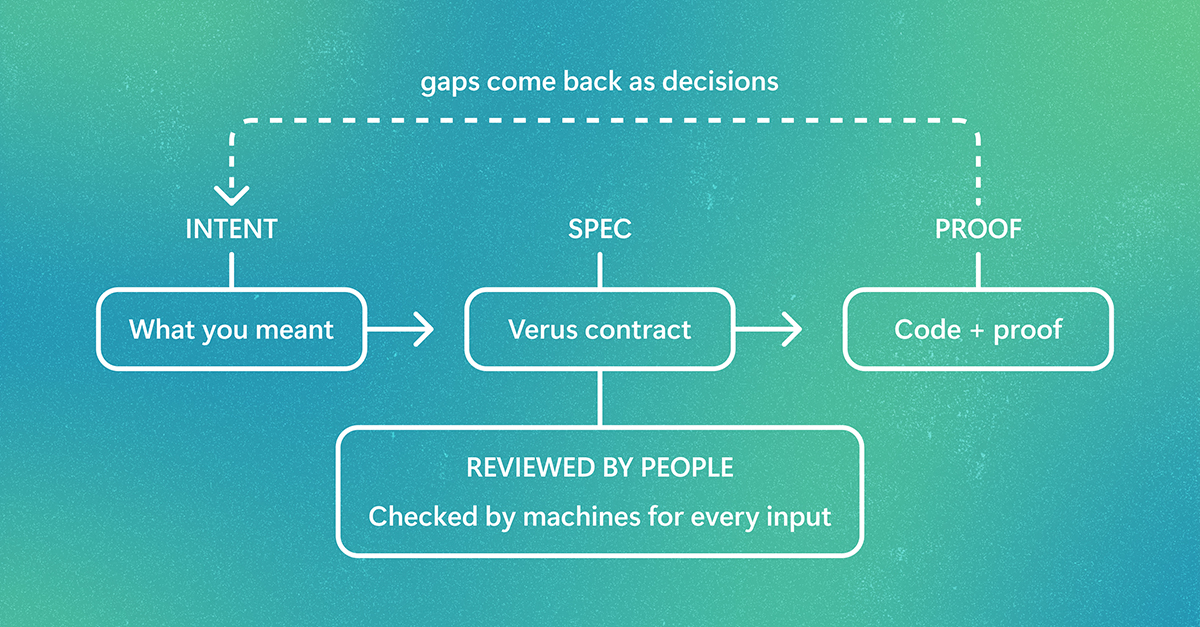
AI agents can generate code at a scale that’s hard for humans to review line-by-line. PDD Kit helps ensure the code is doing what the developer intended by creating formal specifications and testing against them. It converts developer intent into a Verus specification, proves AI-generated code meets it for every input, and uses tests where proofs aren't practical. Developers review intent, not every line. The post Formally verifying agent-written full-stack web apps with PDD Kit appeared first o…
Is your company’s AI sovereign? A practical guide for CIOs on AI vendor lock-in, EU Data Act switching, cloud sovereignty, and testing your exit plan before you need it. The post Sovereignty Is the Option to Leave appeared first on GPT-Lab.
Microsoft Research Blog· microsoft.comOct 30, 2026
Evaluating Microsoft Copilot at enterprise scale requires test data that captures the full complexity of real organizations, yet real enterprise data contains sensitive information that cannot be used for evaluation under any circumstances. The post From synthetic enterprise data evaluations to real Microsoft Copilot AI confidence appeared first on Microsoft Research.
Microsoft Research Blog· microsoft.comOct 29, 2026
Host Sowbhagya Suresh shares some of the latest news and cutting-edge research from across Microsoft—from understanding the challenges facing coding agents to uncovering how people use AI at work and improving extended-range weather forecasting. The post Microsoft Research Focus – Edition #97 appeared first on Microsoft Research.