Nov 2026· Proceedings of the 35th ACM International Conference on Information and Knowledge Management· 0 citations· 15 references
TL;DR
AlphaFold's internal representation linearly encodes residue burial well beyond amino-acid identity, and more sharply than a sequence-only language model, providing an interpretable account of how hydrophobic structural information is reflected in AlphaFold's predictions and representations.
Abstract
AlphaFold predicts protein structure from sequence with remarkable accuracy, yet which physical principles are reflected in its predicted structures and internal representations remains opaque. We ask whether AlphaFold rediscovers the hydrophobic--polar (HP) model (the classical abstraction in which folding is driven by maximizing contacts between hydrophobic residues) using the HP model as an interpretability lens rather than a prediction target. Mining predicted structures from the AlphaFold Protein Structure Database for the E. coli proteome, we reduce each sequence to a binary HP string under a standard hydrophobicity scale and test the central HP hypothesis with a label-permutation null model. AlphaFold structures robustly over-represent hydrophobic contacts (median ≈, 1.8× enrichment, > 97% of proteins), an effect stable across hydrophobicity assignments and contact definitions; yet on short chains they fall short of the extremal compaction an HP optimum would demand, indicating a directional preference rather than an optimized objective. As a complementary probe, we show that AlphaFold's internal representation linearly encodes residue burial ---the structural signature of the hydrophobic effect---well beyond amino-acid identity, and more sharply than a sequence-only language model. Together these analyses bridge a learned predictor and a classical combinatorial model, providing an interpretable account of how hydrophobic structural information is reflected in AlphaFold's predictions and representations.

AlphaFold 3 predicts protein structures with remarkable accuracy, yet how structural information emerges within the model remains poorly understood. Here, through causal interventions on internal representations and direct probing of every Pairformer block, we trace the formation of global protein geometry and identify...
This review synthesizes three complementary strategies for extending AF2 beyond a static prediction by perturbing the multiple sequence alignment (MSA) it receives: sequence-similarity clustering of MSA rows (AF-Cluster), stochastic subsampling of MSA depth combined with dropout and repeated inference, and random maski...
Yu-Qi Sun· Theoretical and Natural Scie...· 0 citations
These findings establish AF3 as reliable for the prediction of monomer disorder but unpredictable for multimers, confirming that disorder prediction emerges from training data, not model design.
Tuan Minh Dao, Sebastien Ghent, V. Uversky et al.· bioRxiv· 4 citations
Beyond predicting unique native globular protein structures, AlphaFold has been used to sample conformational diversity in globular proteins. Here, we asked whether this capacity can be transferred to amyloid fibrils formed by short peptides, despite the fundamental difficulties posed by their polymorphism, sensitivity...
Francesca Peccati· Journal of Chemical Informat...· 0 citations
Modern protein structure predictors learn complex sequence-structure relationships, yet the extent to which their internal representations capture the energetic principles governing protein stability and conformational preferences remains unclear. Here, we introduce DEEP (Distogram Encoded Energetic Potential), a gener...
The site-unspecific couplings are interpreted, which are not influenced by selection for protein folding stability, as the result of variations of global mutational or selective forces across the lineages where the proteins evolve.
Fatemeh Saebi, Jonas Minning, U. Bastolla· Journal of Molecular Evoluti...· 0 citations
Related blog posts
MIT News · Artificial Intelligence· news.mit.eduNov 9, 2026
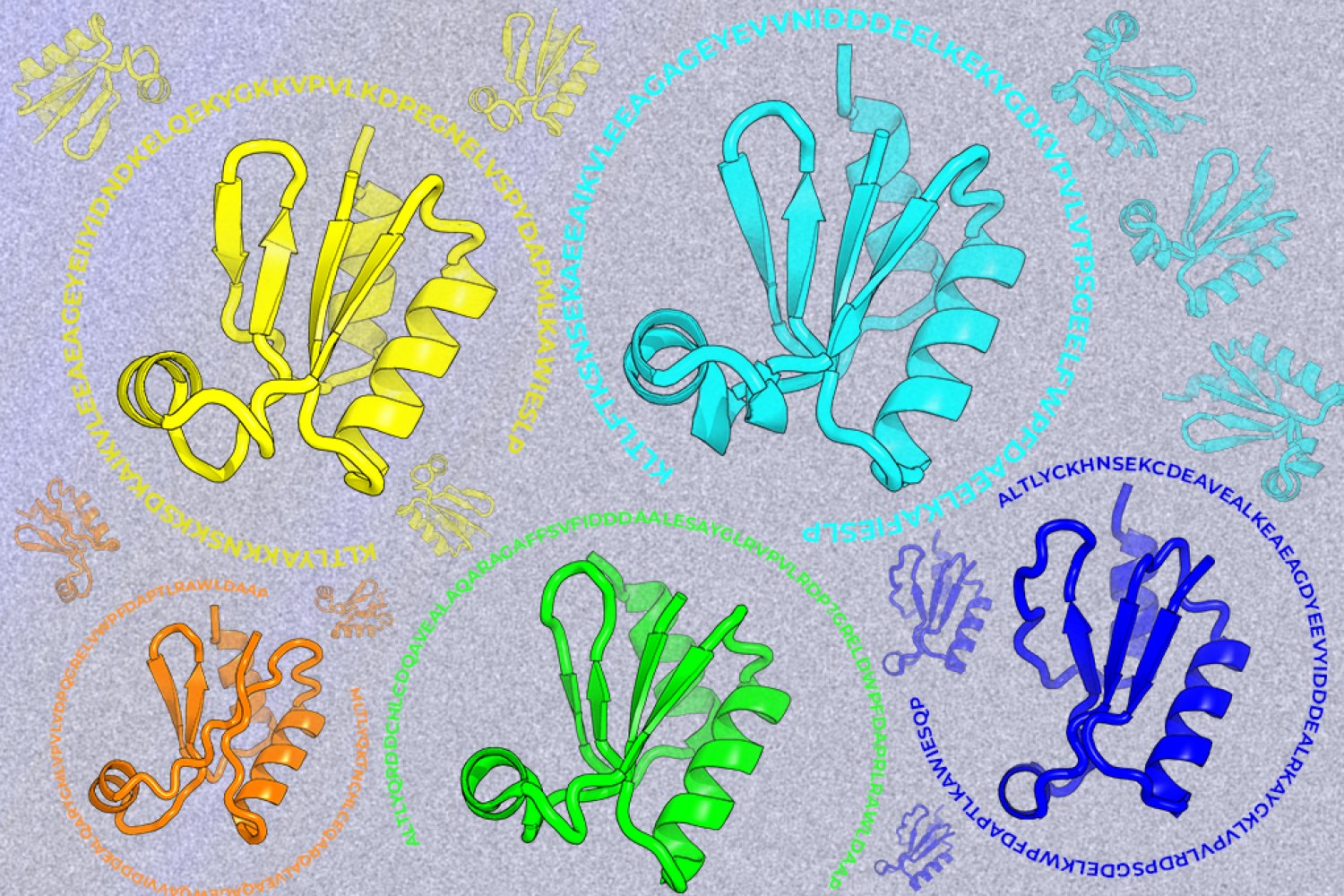
A new machine-learning framework aims to improve the success rate of computational protein design while moving away from results that reproduce sequences found in nature.