RecurTrace introduces Loop Memory Attention, which lets each looped layer attend to its own states from previous iterations along the loop-time axis, so the model can revisit earlier computations instead of relying on the latest state alone.
Abstract
Repeating a small block of middle layers increases a language model's effective inference depth without adding parameters or generating extra tokens, and recent work shows that this latent recurrence improves reasoning. However, two design choices limit these gains. Each iteration sees only the previous output and cannot directly access earlier computations. Moreover, a fixed loop count wastes depth on easy inputs while leaving hard ones with too little computation. We introduce RecurTrace, which addresses both limitations using the loop's own trajectory. Specifically, Loop Memory Attention lets each looped layer attend to its own states from previous iterations along the loop-time axis, so the model can revisit earlier computations instead of relying on the latest state alone. A halting head then reads the loop state and predicts whether to continue, with supervision from an oracle that identifies when additional depth still reduces loss. In a controlled MathQA comparison on the same looped backbone, RecurTrace achieves 56.9% accuracy with an average of 2.0 loops, exceeding the best fixed loop depth by 2.2 points at matched compute. By comparison, ACT and PonderNet collapse to one loop, and CALM reaches only 54.1% with 5.6 loops, while the stronger LoopUS-Conf and TaH-Mismatch baselines reach 55.3% at 3.2 loops and 55.7% at 2.1 loops. Finally, RecurTrace improves generation accuracy over same-budget fine-tuned baselines at 0.6B, 1.7B, 4B, and 8B, with the gain growing with model size from 0.6 to 3.4 points.

Looped language models (LoopLMs) increase computational depth through parameter sharing, offering a path to scale inference computation without adding parameters. However, it remains unclear when additional recurrence is beneficial and how architectural choices affect its effectiveness. Through controlled experiments,...
Xin-Lin Zhuang, Si-Yuan Wang, Imran Razzak et al.· 0 citations
Results show that the benefits of recurrent depth can be retained without repeatedly executing the dense FFN, and view recurrence as repeated composition of a state update and argue that an application is valuable when it exposes a new cross-position influence direction that remains observable at the task readout.
Ruhai Lin, Yi-Yang Guo, Ruiming Zhu et al.· 4 citations
Looped language models separate computational depth from parameter count by repeatedly applying the same transformer block. Adapting these models requires a shared update that remains effective as hidden states evolve throughout the recurrent computation. Our empirical analysis reveals a pronounced late-loop bias in st...
Zi-Rui Zhu, Hai-Lun Xu, Xuan-Lei Zhao et al.· 0 citations
This work proposes Chained Recursive Language Models (Chained RLM), an inference-time architecture, in which the same underlying model is called repeatedly as a sequence of fresh reasoning roots, and studies when fresh-context artifact continuation gives a measurable gain in accuracy over direct LLM answering even with...
Looped Language Models (LoopLMs) perform"latent reasoning"by recursively refining internal latent representations with shared weights, offering a more effective alternative to explicit verbal reasoning. Despite their effectiveness, we find that LoopLMs remain prone to loop instability: unstable refinement across iterat...
Byeongho Yu, Junhyuk So, Eunhyeok Park· 0 citations
Humans and machines often solve harder problems by spending more time on computation. In deep learning, looped models implement this idea during inference by recurrently updating a hidden state. In practice, however, their training backpropagates through only one or a few updates, making it hard to train early updates...
Adaptive AI agents can help make BIM data more machine-readable by navigating IFC models, interpreting inconsistent information, and mapping it to defined standards. In this blog, Alok Rawat shares findings from a real-world pilot in construction workflows. The post Adaptive AI Agents in Construction Workflows appeared first on GPT-Lab.
What does it take to trust AI-driven HVAC optimization? Our AI Model Factory combines agents, machine learning, reinforcement learning and deterministic checks in a governed workflow designed for messy, real-world building data. The post We built an AI factory for HVAC control appeared first on GPT-Lab.
MIT News · Artificial Intelligence· news.mit.eduAug 18, 2026
A new method for surgically removing training examples from a model reveals that as datasets grow, the link between what a model learns and what it produces dissolves.
Microsoft Research Blog· microsoft.comJul 30, 2026
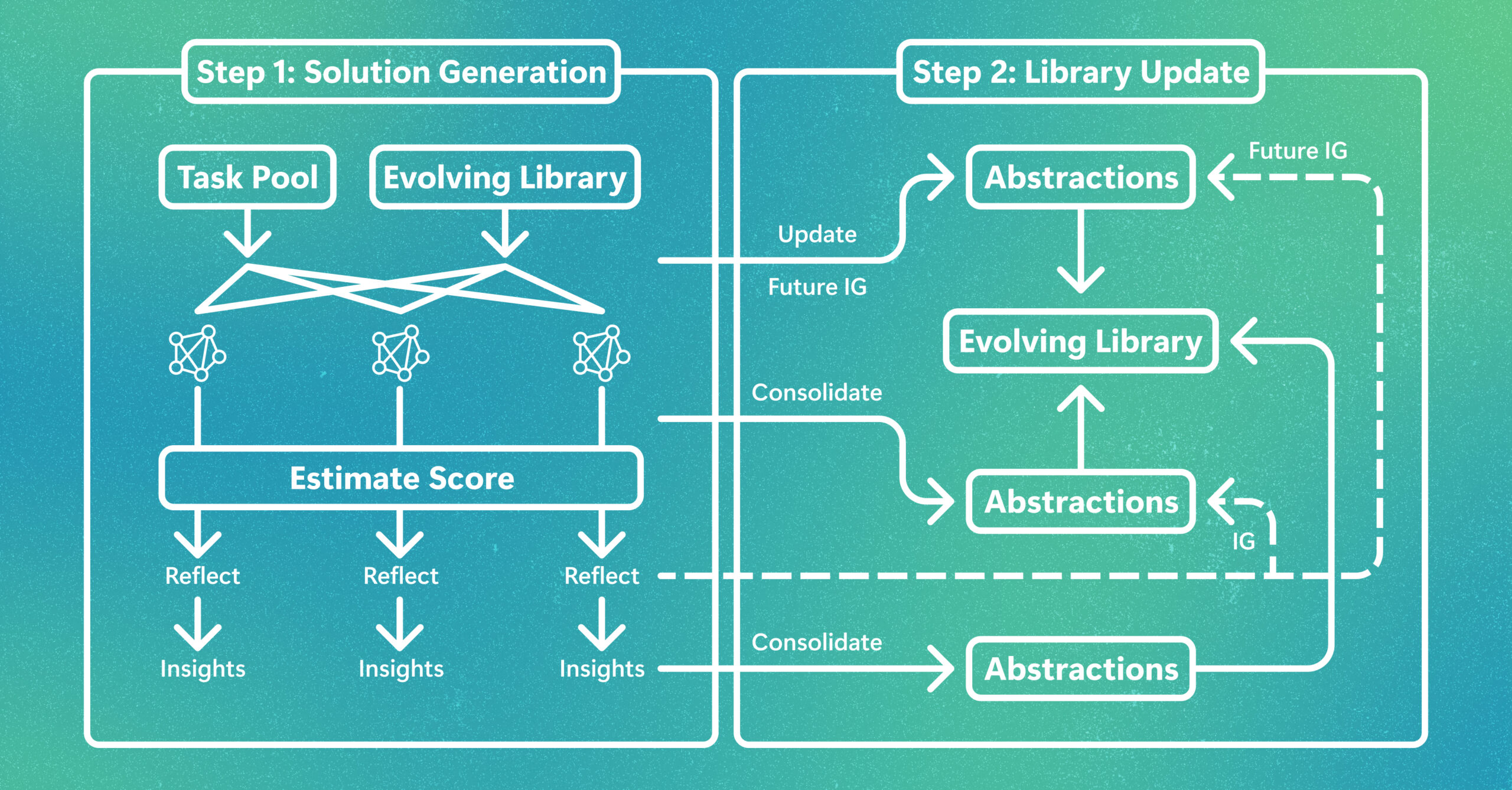
LLMs do not get smarter just by remembering more. EvoLib turns experience into evolving knowledge, taking reusable skills and insights that help models learn and adapt across tasks long after deployment. The post EvoLib: Turning experience into evolving knowledge appeared first on Microsoft Research.
We use cookies to run the site and, with your consent, for analytics and to show ads.
See our Cookie Policy.