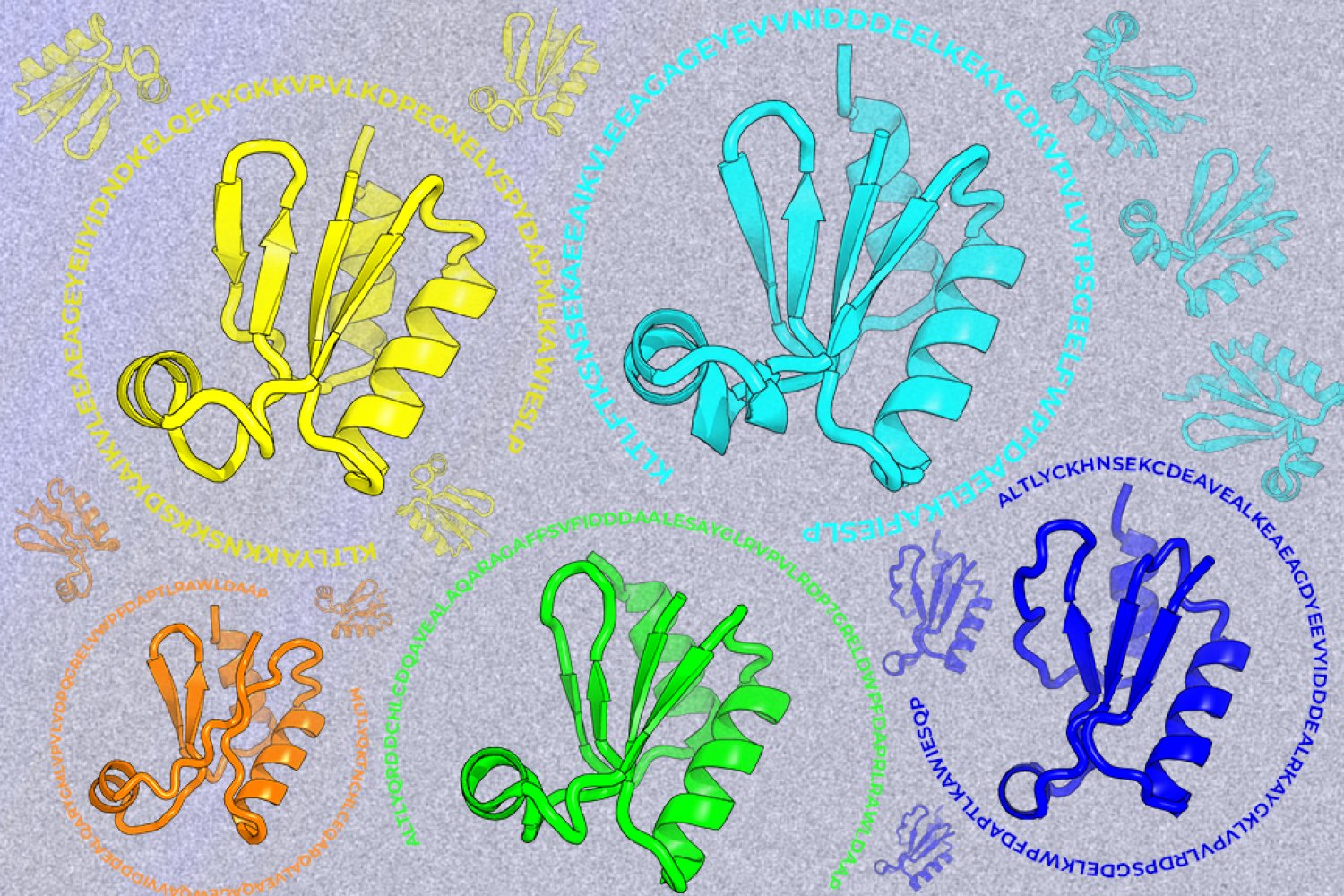
Protein folding is highly sensitive to environmental conditions such as pH, which can influence internal hydrogen bonding and interactions with the solvent, and it is found that pH can shift proteins into or out of the two-state range of k2 values.
Abstract
Protein folding is highly sensitive to environmental conditions such as pH, which can influence internal hydrogen bonding and interactions with the solvent. In this study, we use our FitFoldData online tool to analyze published differential scanning calorimetry (DSC) data on the unfolding of four proteins measured across different pH values. For each dataset, we examine the fitted thermodynamic parameters, including the intrapeptide and peptide–solvent hydrogen-bonding energies (h and hps) and the Zimm–Bragg cooperativity parameter (σ). In the analyzed datasets, under both acidic and alkaline conditions, h and hps range from 2 to 8.5 kJ/mol, while σ is on the order of 10−3 to 10−2. In addition, the two-state cooperativity parameter k2 is estimated from the DSC curves as the enthalpy ratio. By considering the size-dependent relative fluctuation, 1/N, we introduce a “two-state range” around the value k2=1 for each protein with a given number N of peptide units. We find that pH can shift proteins into or out of the two-state range of k2 values.
Intramolecular distances existing between the sheets that define the β-barrel fold of BsCspB have been shown to respond nonuniformly to increasing hydrostatic pressure, suggesting that the three-dimensional structure of native BsCspB is modified such that β-strands depart from each other.
Frédéric Berner, Michael Kovermann· Biophysical Journal· 0 citations
Buffers are commonly selected for their compatibility with biochemical measurements or their specific capabilities, yet buffer interactions with proteins and the surrounding water can actively reshape protein activity, structure, and dynamics. Here, we compare the influences of three widely used electrospray ionization...
Emily Burningham, Carter Lantz, R. Rider et al.· Analytical Chemistry· 0 citations
While most cellular proteins function as oligomers, the mechanisms by which they acquire quaternary structures remain poorly understood. This study analyzes experimental data regarding the dissociation, unfolding, and refolding kinetics of the hexameric Hfq (Y55W) mutant. The dissociation of the Hfq (Y55W) quaternary s...
V. Marchenkov, N. Marchenko, N. Lekontseva et al.· International Journal of Bio...· 0 citations
Isothermal titration calorimetry (ITC) is a powerful label-free method for quantifying protein–DNA interactions, providing direct measurements of binding affinity, stoichiometry, enthalpy, and entropy in a single experiment. However, the quality of protein–DNA ITC data depends strongly on experimental details, includin...
F. Mekkaoui, Sarah A. Looby, Lauren N. Merrikin et al.· Analytical Biochemistry· 0 citations
The hydrophobic effect is often considered a major driving force for molecular recognition in water, whether through classical desolvation of nonpolar surfaces or through the release of confined high-energy water from host cavities. However, the interplay between protonation, ion–dipole interactions, and hydration re...
E. Zaorska, Natasza Jakubik, David A. Rincón et al.· Journal of Physical Chemistr...· 0 citations
The stability and flexibility of peptide structures are strongly influenced by environmental conditions, particularly pH. In this study, we investigate how changes in protonation states of pH-responsive residues modulate non-covalent interaction networks and drive conformational transitions. Using a β-hairpin peptide (...
M. Larocca, Giuseppe Floresta, Daniele Verderese et al.· Frontiers in Chemical Biolog...· 0 citations
A new machine-learning framework aims to improve the success rate of computational protein design while moving away from results that reproduce sequences found in nature.