Next-generation multiplexed targeted proteomics quantifies post-translational modifications in disease and compound-protein interactions with high throughput
Aug 2026· Nature Communications· Vol 17· 0 citations· 37 references
Medicine
TL;DR
Improvements enabling quantification of site-specific modifications, including post-translational modifications and covalent compound-protein interactions spanning diverse pathways are described.
Abstract
The GoDig platform enables sensitive, multiplexed targeted pathway proteomics without manual scheduling or synthetic standards. Here we present GoDig 2.0, which increases sample multiplexing to 35-fold, improves time efficiency and reduces scan delays for higher success rates, and allows flexible spectral and elution library generation from different mass spectrometry data types. GoDig 2.0 measures 2.4× more targets than GoDig 1.0, quantifying >99% of 800 peptides in a single run. We compile a library of 23,989 human phosphorylation sites from a phosphoproteomic dataset and use it to profile kinase signaling differences across cell lines. In human brain tissue, we establish a hyperphosphorylated tau assay including pTau127, revealing potential biomarkers for Alzheimer’s disease. We also quantify diglycyl-lysine peptides to assess polyubiquitin branching. Finally, we build a library of 20,946 reactive cysteines and profile covalent compound-protein interactions spanning diverse pathways. GoDig 2.0 enables high-throughput analyses of site-specific protein modifications across many biological contexts. Targeted multiplexed proteomic technologies enable quantification of target proteins without prior assay development. Here, the authors describe improvements enabling quantification of site-specific modifications, including post-translational modifications and covalent compound-protein interactions.

This study constructed a pH-responsive P-TN/SF@Fe-Cur composite coating that demonstrated significant anti-infective, anti-inflammatory, antioxidant, pro-angiogenic, and pro-osteogenic effects in rat subcutaneous infection and femoral defect models.
The results show that alternative transcript diversity extensively enters translation-supported proteoform space and establish a systematic link between transcript variation and protein functional diversification.
Felicia T. Jiang, Dengwang Chen, Ziwei Wang et al.· bioRxiv· 1 citation
Due to its importance and wide adoption, wheat cultivation is promptly required to shift towards sustainable practices, reducing the dependency on chemical components. Among bio-based solutions aimed at securing the sustainability of wheat cultivation, biostimulants offer a versatile platform of eco-friendly tools assuring sustainability and profitability. Microalgae present a concrete example of a biostimulant source due to their richness in metabolites and high value products. Therefore, this study evaluated the biostimulant potential of eleven eco-extracts prepared from soil-isolated microalgae strains. Eco-extracts applied via soil drench at low dose (0.1 g/L) were investigated for their biostimulant effects on wheat growth, physiology, yield, and quality under controlled conditions. Results demonstrated significant ameliorations in treated plants as compared to the control, with no phytoinhibitory effects. Remarkable enhancements were notable in growth parameters such as shoot and root lengths (+40-70%), physiological traits such as total chlorophyll and stomatal conductance (+7-52%), yield components in the example of grain number per spike and thousand grain weight (+17-103%), and grain quality namely protein and polyphenol content (+2-fold to 4-fold). Similarly, phosphorus accumulation and uptake were significantly improved, while soil physicochemical status was ameliorated, indicating enhanced fertility. Multivariate analysis and composite index ranking marked Chlorella sp. GA18, Chlorella sp. GA65, Scenedesmus sp. GA69, and Chlorococcum sp. GA63 as eco-extracts with consistent performances across all plant traits. These findings highlighted the promising potential of integrating microalgae-based eco-friendly extracts in sustainable wheat cultivation.
Amer Chabili, Z. Hakkoum, F. Minaoui et al.· Plant Science· 1 citation
ProteinReasoner is developed, a multimodal generative protein foundation model that sequentially connects amino acid sequence, evolutionary constraints and three-dimensional structure within a shared autoregressive architecture and suggests a general route towards reasoning across interdependent representations in other scientific domains.
Chaozhong Liu, Linlin Chao, Shaomin Ji et al.· bioRxiv· 1 citation
HydroGym is introduced, a solver-independent reinforcement learning platform providing more than 60 validated, openly available flow control environments spanning from canonical laminar flows to complex turbulent flows, with systematic progression in the Reynolds number up to Re = 4 × 10⁵, and Mach number variations in two and three dimensions.
Christian Lagemann, Sajeda Mokbel, Miro Gondrum et al.· Nature· 1 citation
A protein's function follows from the structure it adopts, and which structure that is depends on the pathway taken. In programmable matter the target is fixed before assembly, and whatever else forms is treated as error. Here we show that pathways themselves form a design space. Using reinforcement learning, we fold model DNA-coated droplet chains into rigid two-dimensional geometries, uncovering two classes of pathways: downhill, in which bonds are only added, and detour, in which bonds are broken and remade before the target is reached: for some the only route that exists. Coarse-graining pathways by interactions gives experimentally realizable protocols. Some produce one geometry, others several: structures sharing a detour route can be cycled between, while those that coexist assemble into superstructures inaccessible to a uniform product. Function emerges from the pathways rather than being designed. Designing the process instead of the components could give colloidal materials that reconfigure and repair themselves on demand.
Unknown authors· 0 citations
Related blog posts
MIT News · Artificial Intelligence· news.mit.eduAug 27, 2026
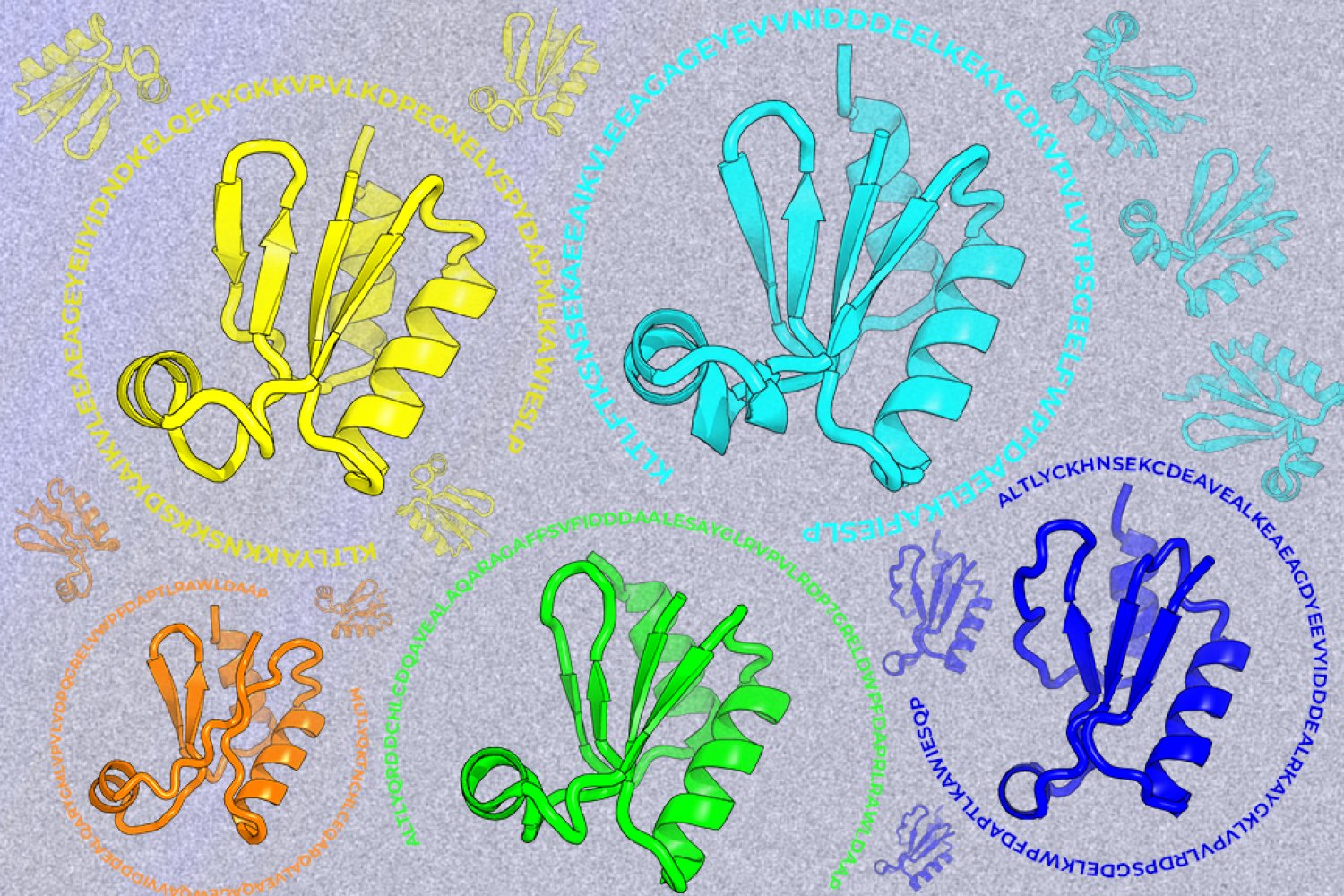
A new machine-learning framework aims to improve the success rate of computational protein design while moving away from results that reproduce sequences found in nature.